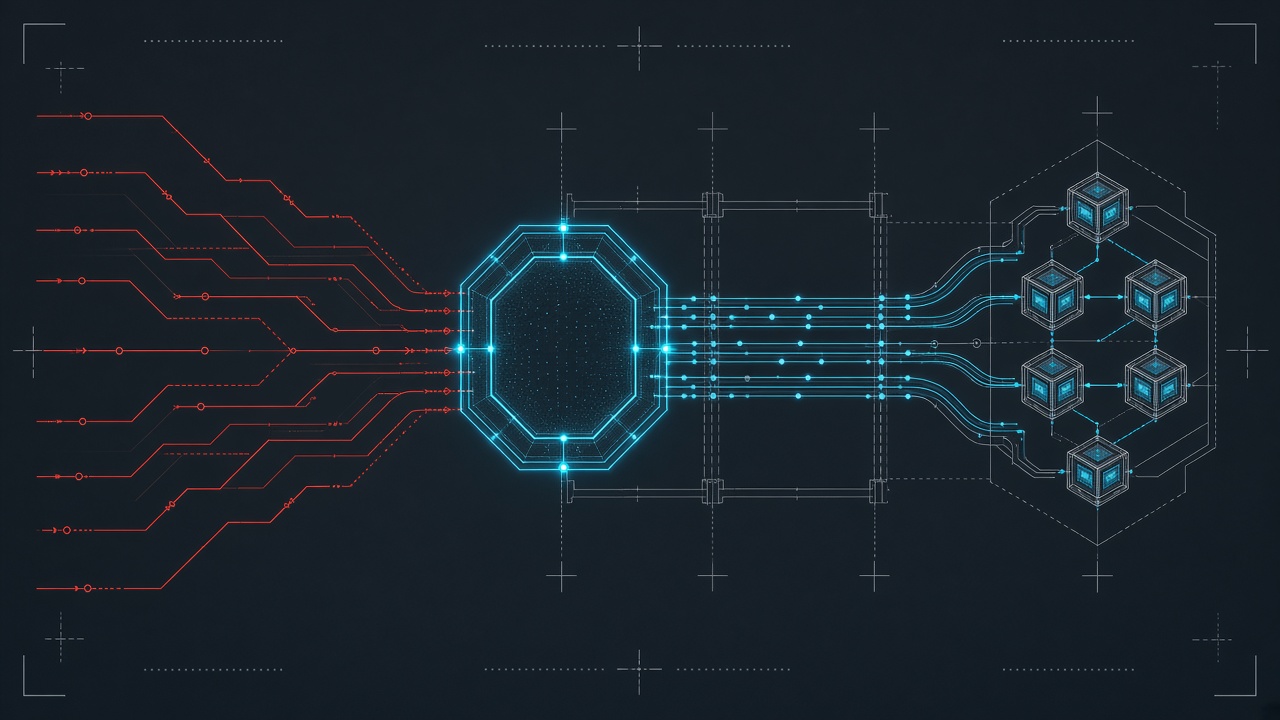
A safety refusal from a commercial frontier model is not an enterprise security control. It is a vendor-configured output filter. When an API declines to answer a prompt with canned boilerplate, it tells you what that vendor’s safety alignment team decided to suppress. It tells you nothing about whether your application architecture can withstand a real attack.
In the open-weight ecosystem, that distinction stopped being theoretical in 2024. Researchers proved that refusal behavior in large language models is mediated by a single linear direction in internal activation space. By identifying that vector and modifying the model’s weight matrices, developers can remove refusal behaviors in minutes on consumer hardware without fine-tuning, without gradient descent, and without degrading benchmark performance.
This technique is known as abliteration (a portmanteau of ablation and obliteration).
For defensive cybersecurity teams, abliterated models solve a painful operational bottleneck: commercial safety filters constantly refuse legitimate vulnerability analysis, malware triage, and red-team adversary simulations. For threat actors, abliteration eliminates the friction of prompt jailbreaking, providing unrestricted, offline language models that assist with exploit development, automated reconnaissance, and spear-phishing.
Understanding abliteration is required reading for anyone defending modern infrastructure. If your security architecture relies on an upstream model refusing to cooperate with an adversary, your defense is already broken.

The Mechanics: Representation Engineering in Weight Space
To understand why abliterated models cannot be stopped by provider terms of service, you have to look at how transformer architectures process instructions.
The Single Refusal Direction Discovery
In June 2024, researchers Andy Arditi, Oscar Balcells Obeso, Aaquib Syed, Daniel Paleka, Nina Rimsky, Wes Gurnee, and Neel Nanda published foundational mechanistic interpretability research titled “Refusal in Language Models Is Mediated by a Single Direction” (arXiv:2406.11717, NeurIPS 2024).
Investigating popular open-weight chat models (including Llama-3-8B-Instruct, Qwen, and Gemma), the researchers examined the residual streams of transformer blocks. In autoregressive decoders, each token passes through alternating self-attention and multi-layer perceptron (MLP) layers, writing intermediate state updates to a shared residual stream.
The authors uncovered an unexpected geometric simplicity: across 13 distinct instruction-tuned models, the complex behavioral decision to refuse a request is represented by a one-dimensional subspace (a single directional vector) in the model’s activations.
When a prompt enters the network containing concepts that trigger safety training (Reinforcement Learning from Human Feedback, Direct Preference Optimization, or constitutional AI rules), the hidden states across middle-to-late transformer layers shift sharply along this specific axis. If activation along this refusal vector crosses a threshold, the model outputs canned refusal tokens: “I cannot fulfill this request…”
The researchers demonstrated two critical operations:
- Activation Steering (Addition): Adding this directional vector to the residual stream of a benign request causes the model to refuse harmless prompts (for example, asking how to bake a sourdough loaf).
- Activation Ablation (Subtraction): Projecting activations to remove this directional component causes the model to answer previously forbidden prompts without hesitation.
From Runtime Ablation to Permanent Weight-Space Editing
While Arditi et al. initially demonstrated runtime activation clamping, open-source researchers (notably developer FailSpy via the abliterator library, followed by projects like p-e-w/heretic and checkpoints published by Maxime Labonne) operationalized this into permanent weight edits.
Abliteration does not require re-training the neural network. The process works mathematically in four deterministic steps:
- Contrastive Activation Profiling: Pass two parallel datasets through the target model: a set of harmful instructions (e.g., malware design, vulnerability exploitation queries) and a matched set of harmless instructions (e.g., standard coding questions).
- Mean Difference Extraction: Record the activations at the residual stream across every layer at the final token position. Calculate the mean difference between the harmful and harmless activation distributions: $$\vec{r} = \mu_{\text{harmful}} - \mu_{\text{harmless}}$$ Normalizing $\vec{r}$ yields the unit refusal direction vector $\hat{r}$.
- Layer Selection: Measure which transformer layers exhibit the highest separation along $\hat{r}$ (typically concentrated in the middle layers, such as layers 12 through 20 in a 32-layer architecture).
- Orthogonal Weight Projection: For each target layer, modify the output projection matrices (such as the attention output projection $W_o$ and the MLP down-projection $W_{\text{down}}$) so their output space is orthogonal to the refusal vector $\hat{r}$: $$W’ = W - \hat{r} (\hat{r}^T W)$$
The resulting modified weights $W’$ are saved back to disk in standard SafeTensors format.
Because the modification is a surgical geometric projection, the model’s underlying linguistic knowledge, syntax parsing, reasoning logic, and instruction-following abilities remain intact. Standard evaluation suites (MMLU, GSM8K, HumanEval, and SWE-bench) show virtually zero statistical degradation between baseline instruction-tuned models and their abliterated counterparts. The only thing erased is the model’s internal mechanism for saying no.
| Parameter | Traditional Fine-Tuning (SFT / DPO) | Prompt Jailbreaking (DAN, Roleplay) | Mathematical Abliteration |
|---|---|---|---|
| Compute Required | High (Multi-GPU clusters, hours to days) | Zero (Pure inference text) | Negligible (Consumer GPU, 5 to 15 minutes) |
| Durability | Permanent in weights | Fragile (Breaks across versions/system prompts) | Permanent in weights |
| Mechanism | Gradient descent weight updates | Context window semantic confusion | Orthogonal vector projection on weight tensors |
| Benchmark Impact | Risk of catastrophic forgetting | Zero impact on weights | Zero measurable capability loss |
| Reversibility | Requires retraining | Easily patched via prompt guards | Irreversible on modified tensor files |

Defensive Refusal Bias: Why Security Teams Need Uncensored Weights
To understand why security practitioners build and deploy abliterated models, you must understand the daily frustration of defensive security operations: false-positive refusal bias.
Major frontier model providers (OpenAI, Anthropic, Google) face intense regulatory scrutiny and corporate liability risks. As a result, commercial alignment pipelines err on the side of aggressive over-refusal. Commercial safety classifiers frequently trigger on raw cybersecurity vocabulary regardless of context or intent.
Consider what happens when an on-call security engineer pastes an obfuscated PowerShell dropper into a commercial assistant to extract its command-and-control IP addresses:
"I'm sorry, but I cannot assist with analyzing or executing scripts
designed for unauthorized system access or malicious activities."
The incident responder is not asking for an exploit; they are actively containing a live breach. Yet commercial alignment treats the defensive triage request identically to an offensive attack.
The same failure modes cripple everyday defensive workflows:
- Malware Analysis and Signature Generation: Asking an aligned model to identify unpacking routines in an assembly dump or to write a YARA / Sigma detection rule for a specific ransomware family frequently triggers refusal barriers.
- Vulnerability Reproduction (Patch Verification): When an internal security team verifies that a disclosed CVE has been patched in their staging environment, they need to generate a functional proof-of-concept (PoC) script. Aligned models decline to generate exploit-shaped syntax, forcing engineers back to manual assembly.
- RAG & Agent Prompt Injection Testing: When red teams test their own customer-facing applications against indirect prompt injection (as detailed in our prompt injection protection guide), they need an assistant that will faithfully execute adversarial payloads without moralizing lectures. If the red team’s testing LLM refuses to generate test attacks, the security team cannot verify whether the application’s actual input filters work.
When defenders are locked out by rigid provider guardrails, they turn to local open weights. Running an abliterated Llama-3.3-70B, Qwen-2.5-72B, or Mistral checkpoint locally through vLLM or Ollama gives security teams an analyst that reliably answers technical queries, decompiles suspicious routines, drafts detection rules, and simulates adversarial behavior on demand.
The Threat Landscape: How Threat Actors Exploit Abliteration
The exact properties that make abliterated models indispensable for authorized red teams make them equally dangerous in the hands of malicious threat actors.
A critical reality of neural network training is that pre-training corpora already contain massive volumes of dual-use technical knowledge. Base models ingest public GitHub repositories, CVE disclosures, Metasploit modules, Linux kernel internals, C networking code, and academic security papers. The base model already knows how software exploits work; alignment was simply a polite behavioral lock placed on the door.
Abliteration cuts that lock off the hinges.
When a cybercriminal downloads an abliterated weight from Hugging Face or runs an open-source tool like heretic against a state-of-the-art open-weight checkpoint, three structural shifts occur:
1. Offline, Untraceable Threat Generation
Commercial frontier APIs enforce rate limits, mandatory user accounts, IP logging, and output filtering. Malicious actors using proprietary APIs face account suspension and law enforcement subpoenas.
An abliterated model running locally on a high-end consumer GPU (such as an Nvidia RTX 4090 or Apple Silicon Mac Studio) operates completely air-gapped. There are no API keys, no audit logs, no acceptable use policies, and zero telemetry leaving the machine. Threat actors can query the model millions of times to generate malicious artifacts without detection.
2. Lowering the Skill Floor for Intrusion
Prior to uncensored models, developing targeted spear-phishing campaigns or modifying public exploits required domain competence. An abliterated model allows entry-level script kiddies to:
- Generate context-aware phishing emails tailored to specific corporate executive hierarchies, complete with authentic industry jargon and persuasive pretexting.
- Rewrite public exploit scripts to bypass static signature detection (polymorphic code variation).
- Synthesize shellcode encoders and packers that defeat standard Antivirus (AV) and Endpoint Detection and Response (EDR) heuristics.
3. Autonomous Offensive Agent Swarms
As security operations evolve toward agentic architectures, adversaries are deploying the same technology offensively. By connecting an abliterated model to an execution runtime with command-line tools (Nmap, Metasploit, SQLmap, Burp Suite), threat actors can construct autonomous offensive agents. Because the abliterated model never halts on safety refusals, it can run unattended for hours: scanning network subnets, parsing service banners, attempting exploit payloads, and adapting its attack path based on error output.
The Rise of Hosted Unrestricted APIs
While open-weight files require local compute, commercial entities have begun monetizing hosted refusal-removed endpoints. Startups like Abliteration.ai emerged in 2026 to offer hosted copies of modified weights (such as GLM and DeepSeek variants) behind standard OpenAI-compatible API endpoints.
Independent investigative press testing (including a September 2026 TechCrunch evaluation) demonstrated that hosted refusal-removed platforms answered requests for functional credential-stealing programs and dangerous biological protocols directly through standard browser sessions. While hosted vendors market their platforms as tools for red teams and penetration testers, card-only payment processing and minimal identity verification mean threat actors can access high-capability uncensored reasoning without owning local hardware.

The Architectural Flaw: Why Provider Refusal Is Not a Security Control
The emergence of abliterated models exposes a fatal flaw in how many software teams design AI applications.
When a team builds an AI agent, internal assistant, or automated workflow, they often rely on the upstream foundation model to act as their security boundary. They assume that because Claude, GPT-4o, or Gemini refuses to output harmful content in testing, the application is inherently safe.
This is an illusion of security for three fundamental reasons:
- Jailbreak Volatility: Prompt-level jailbreaks (many-shot jailbreaking, ASCII encoding, base64 obfuscation, virtual persona framing) bypass safety filters without modifying a single weight.
- Indirect Injection Vulnerability: If your production assistant reads untrusted external data (emails, support tickets, web pages, database records), an attacker can embed hidden instructions in that data. The model processes the untrusted input as instructions, executing tool calls or exfiltrating data behind your back.
- The Open-Weight Reality: If an adversary targets your exposed API endpoints, they are not bound by your choice of foundation model. They can query your system using an abliterated local model running in their own environment.
If your application breaks the moment an upstream model decides to answer a question, you do not have an application security architecture. You have a vendor dependency.
The Decoupled Policy Gateway Pattern
Defensible AI engineering requires separating model execution from policy enforcement. Whether you are calling a commercial API or running an abliterated open weight in a private cluster, the model must be treated as an untrusted computation engine surrounded by external, deterministic security boundaries.
An effective enterprise AI firewall sits directly between the application layer and the model runtime, enforcing five discrete outcomes:
- Allow: The request passes all boundary checks and proceeds to the model unmodified.
- Refuse: The gateway halts execution deterministically before the request reaches the model, returning a structured error code to the caller.
- Rewrite: The gateway sanitizes or re-prompts the instruction to remove prompt injection artifacts or policy-violating framing.
- Redact: Inbound secrets, customer PII, session tokens, and credentials are wiped using deterministic regular expressions and named-entity recognition (NER) models before the prompt reaches model context.
- Escalate: High-risk tool invocations (such as database deletions, wire transfers, or permission changes) are routed to a human reviewer in the loop.
By moving policy enforcement out of the model’s weights and into an external gateway (using tools like LiteLLM, NeMo Guardrails, or custom reverse proxies), your security posture remains identical whether the underlying model is a locked-down proprietary API or an abliterated local weight.
+-----------------------------------------------------------------------------------+
|                           ENTERPRISE NETWORK PERIMETER                            |
|                                                                                   |
|  [ Inbound Request ]                                                              |
|          |                                                                        |
|          v                                                                        |
|  +-----------------------------------------------------------------------------+  |
|  |                         INDEPENDENT POLICY GATEWAY                          |  |
|  |  * Deterministic regex & PII redactor (strips credentials, keys, PII)       |  |
|  |  * AST semantic parser & Prompt injection classifier                       |  |
|  |  * Tool-call permission boundary & role-based access control (RBAC)         |  |
|  +-----------------------------------------------------------------------------+  |
|          |                                              |                         |
|   (Pass / Redacted)                             (Violations Blocked)              |
|          |                                              |                         |
|          v                                              v                         |
|  +---------------------------+              +-----------------------+             |
|  |   SANDBOXED MODEL CORE    |              |  STRUCTURED AUDIT LOG |             |
|  | (Local Abliterated Weight |              |  * SIEM Event Stream  |             |
|  |  or Commercial Endpoint)  |              |  * Policy Reason Code |             |
|  +---------------------------+              |  * Caller ID / Scope  |             |
|          |                                  +-----------------------+             |
|          v                                                                        |
|  +-----------------------------------------------------------------------------+  |
|  |                         OUTBOUND EGRESS INSPECTION                          |  |
|  |  * Secret exfiltration scanner (canary tokens, system prompt leaks)         |  |
|  |  * Hallucinated command sanitizer                                           |  |
|  +-----------------------------------------------------------------------------+  |
|          |                                                                        |
|          v                                                                        |
|  [ Clean Validated Response ]                                                     |
+-----------------------------------------------------------------------------------+
Enterprise Playbook: Running and Defending Against Abliterated Models
Security leaders need a two-part operational strategy: how to safely deploy abliterated models for authorized defensive operations, and how to defend the enterprise from adversaries wielding them.
Part 1: Operationalizing Abliterated Models for Defense
If your internal red team, vulnerability research unit, or trust-and-safety team requires an abliterated model for legitimate testing, enforce these non-negotiable operational controls:
- Air-Gapped Enclave Deployment: Host abliterated weights on private virtual machines or on-premise hardware inside an isolated VPC. Block all outbound internet access from the host container to prevent accidental telemetry transmission or data exfiltration.
- Zero Access to Production IAM Credentials: Never grant an abliterated model container access to production databases, cloud provider IAM roles, or live API tokens. The model should exist strictly within a disposable sandbox.
- Cryptographically Scoped Ephemeral Keys: Issue single-use, time-bound API credentials for specific testing engagements. Revoke keys immediately upon completion of the engagement. Never permit shared team keys.
- Structured SIEM Audit Streaming: Stream every input hash, timestamp, user identity, project code, and model response to your central SIEM (Splunk, Elastic, Datadog). Retain an immutable audit trail verifying that all queries fell strictly within the written penetration testing scope.
- Adversarial Baseline Evaluation: Use abliterated models to benchmark your own defensive guardrails. Run known attack datasets (such as CyberSecEval or synthetic prompt injections) through your application’s input firewalls with an abliterated model as the backend. If the hostile query produces a successful exploit, your application guardrails failed. This evaluation methodology is identical to the testing habits outlined in our guide on automated LLM output evaluation.
Part 2: Defending Against Adversarial Use of Uncensored AI
To protect your organization from external adversaries using abliterated models:
- Egress Monitoring for Shadow Local LLMs: Monitor corporate network egress and workstation telemetry for local model runtimes (Ollama, LM Studio, llama.cpp, vLLM). Engineers frequently download unapproved abliterated models onto company laptops to bypass corporate AI policies, creating unmonitored data-leakage channels. Pair this monitoring with the governance frameworks detailed in our breakdown of hidden costs of running AI in production.
- Assume Zero Upstream Restraint: When auditing third-party integrations, customer-facing agents, or multi-tenant workflows (as covered in our guide on production LLM applications), design every security check under the assumption that incoming text was generated by a fully unaligned, hostile LLM.
- Implement Output Canary Tokens: Inject unique, randomized canary tokens into internal system prompts and backend RAG data stores. If an abliterated model or external injection attempts to exfiltrate context, your egress filter detects the canary string and kills the network socket instantly.

Conclusion
Abliteration resolved a fundamental debate in machine learning: it proved that behavioral alignment in open-weight models is mathematically fragile. By identifying and removing the single linear vector responsible for refusals, representation engineering eliminated the barrier between what a foundation model knows and what it will say.
For cyber defense, abliteration is both a necessary tool and a serious threat. It liberates red teams, incident responders, and vulnerability researchers from the paralyzing false positives of over-aligned commercial APIs, allowing them to test defenses against realistic, hostile inputs. Concurrently, it places unrestricted, highly capable software engineering and exploitation power into the hands of threat actors operating completely offline.
The strategic takeaway for engineering leaders is clear: stop relying on upstream model refusals as a security boundary. Model alignment is a vendor feature, not a defense. True security requires building independent, deterministic policy gateways, validating all inputs and outputs at the application boundary, and designing your architecture so that it remains secure even when the model will comply with anything.