Elevate Your Online Presence: How vComply Achieves Website Accessibility Compliance
A website is often the first point of contact between a business and its potential customers. For over 1.3 billion people worldwide living with disabilities, inaccessible websites create barriers that deny equal access to information and services. With 95.9% of top websites failing basic accessibility standards, ensuring your site is inclusive is not just the right thing to do - it is a legal and business necessity.
This article covers the importance of web accessibility compliance, how vComply simplifies the path to inclusivity, and the concrete value it delivers to businesses and users.
The Imperative of Web Accessibility: Beyond Compliance
The Legal Landscape: ADA and WCAG
The legal framework for web accessibility centers on the Americans with Disabilities Act (ADA) in the United States and the internationally recognized Web Content Accessibility Guidelines (WCAG).
ADA Compliance: The ADA prohibits discrimination against individuals with disabilities in all areas of public life, including public accommodations. While the ADA does not explicitly define website accessibility standards, courts have consistently applied it to digital spaces. WCAG serves as the de facto standard for ADA website compliance.
WCAG Guidelines: Developed by the W3C, WCAG provides thorough guidelines organized into four core principles - POUR:
-
Perceivable: Information must be presentable in ways users can perceive. This means text alternatives for non-text content, sufficient color contrast, and content that can be presented in different ways without losing meaning.
-
Operable: Interface components and navigation must be operable. All functionality must be available via keyboard, users must have enough time to interact, and content must not cause seizures or physical reactions.
-
Understandable: Information and UI operation must be understandable. Use clear and consistent language, make pages appear and operate predictably, and help users avoid and correct mistakes.
-
Reliable: Content must work with current and future assistive technologies. Use valid HTML, provide proper document structure, and ensure compatibility with screen readers and other tools.
Complying with these standards mitigates legal risks and significantly expands your potential audience. For a deeper start with compliance requirements, see our ADA and WCAG compliance guide.
The Business Case: A Wider Audience and Enhanced Reputation
Beyond legal obligations, accessibility delivers measurable business advantages:
- Expanded Market Reach: People with disabilities represent substantial spending power. An accessible website opens this market segment.
- Improved User Experience for All: Clear navigation, structured content, and good contrast benefit every visitor - including those with temporary impairments, situational limitations, or slow internet connections.
- Enhanced SEO: Search engines prioritize user experience. Accessible websites typically have better-structured code, clear headings, and descriptive alt text, all of which contribute to higher rankings.
- Positive Brand Image: A visible commitment to inclusivity builds trust and loyalty among customers who value equality.
Introducing vComply: Your Partner in Accessibility
Achieving and maintaining web accessibility can seem daunting, especially for businesses with limited resources or technical expertise. vComply is an accessibility widget designed to help websites become compliant by providing a user-friendly interface and automated adjustments.
How vComply Works to Foster Compliance
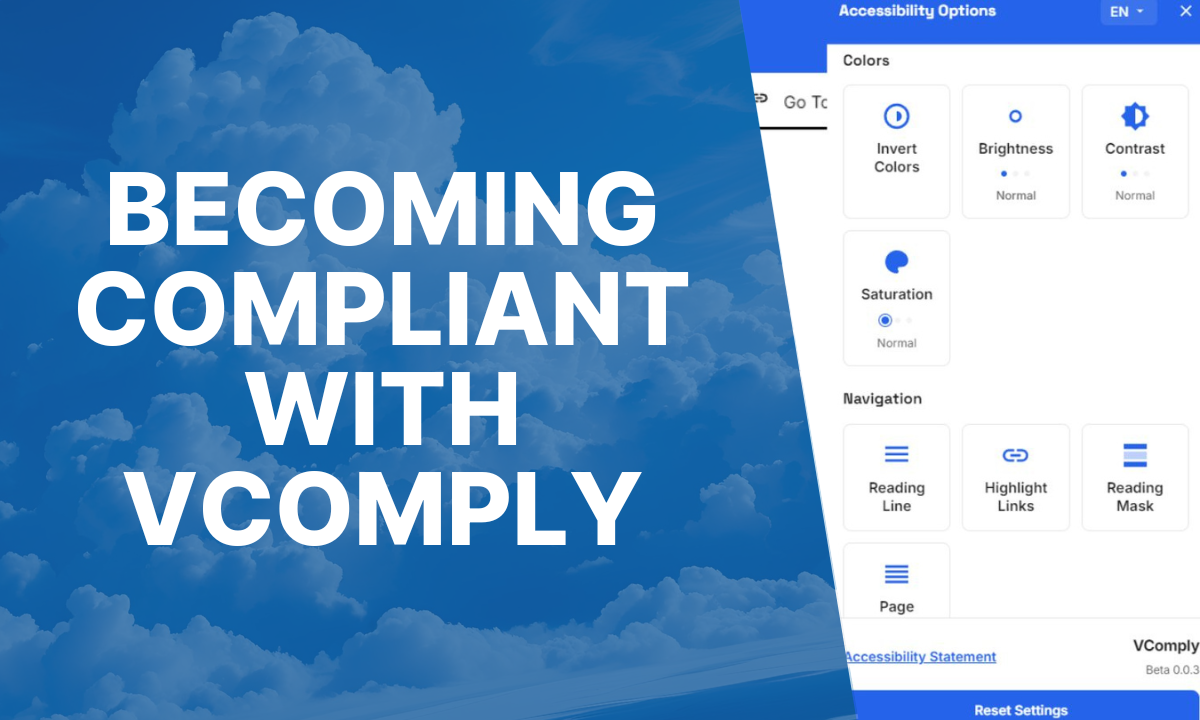
vComply’s core strength is its customizable accessibility interface, which allows users to tailor their browsing experience to their specific needs. This addresses many common accessibility barriers without requiring extensive website re-coding.
Text Adjustments:
- Font Sizing: Users can increase or decrease font sizes for better readability.
- Text Spacing: Adjusting line height, letter spacing, and word spacing improves readability for users with dyslexia or cognitive processing challenges.
- Font Family: Switching to more readable fonts aids those with reading difficulties.
- Text Alignment: Options for left, center, or right alignment cater to various reading preferences.
- Highlight Titles/Links/Focus: Highlighting these elements helps users quickly identify important information and move through the page.
Color and Display Adjustments:
- High Contrast: Switches to high-contrast color schemes for users with visual impairments.
- Dark Contrast: Provides a dark mode option to reduce eye strain.
- Light Contrast: Offers a light mode for those who prefer it.
- Monochrome: Renders the website in grayscale, beneficial for individuals with color blindness.
- Saturation: Adjusting color saturation helps users distinguish between elements.
- Color Contrast: Directly addresses WCAG guidelines for minimum contrast ratios.
Navigation and Content Aids:
- Magnifier: A virtual magnifying glass allows users to zoom in on specific areas.
- Reading Mask: Highlights a specific line of text to aid focus for users with attention deficits.
- Reading Guide: Provides a horizontal line that helps users track reading progress.
- Big Cursor: Enlarges the mouse cursor for easier visibility and control.
- Mute Sounds: Allows users to mute all website sounds.
- Hide Images: Provides an option to hide images, reducing visual clutter and speeding up page loading.
By offering these direct user controls, vComply tackles many WCAG 2.1 Level AA success criteria. It enables individual users to customize their experience without requiring the website owner to implement complex code changes for every possible accessibility need.
The Value Proposition: Why Choose vComply?
Implementing vComply delivers substantial value:
- Instant Accessibility Enhancements: Unlike manual remediation, which is time-consuming and expensive, vComply offers immediate improvements upon integration.
- User Enablement: Giving users direct control over their browsing experience fosters a more inclusive and enjoyable digital environment.
- Reduced Legal Risk: By addressing a broad spectrum of WCAG guidelines, vComply helps businesses proactively mitigate the risk of accessibility-related lawsuits.
- Cost-Effectiveness: Compared to full manual audits and custom development, an accessibility widget is a budget-friendly solution for significant accessibility improvements.
- Ease of Implementation: The widget integrates into existing websites with minimal technical effort, typically by embedding a small code snippet.
- Maintaining Compliance: As digital landscapes and accessibility guidelines evolve, a dynamic solution like vComply can adapt to help ensure ongoing compliance.
For businesses aiming to broaden their reach, enhance user experience, and uphold their commitment to inclusivity, vComply provides a practical pathway to achieving website accessibility compliance. Embracing web accessibility is not just about meeting legal requirements - it is about building a truly inclusive digital world for everyone.