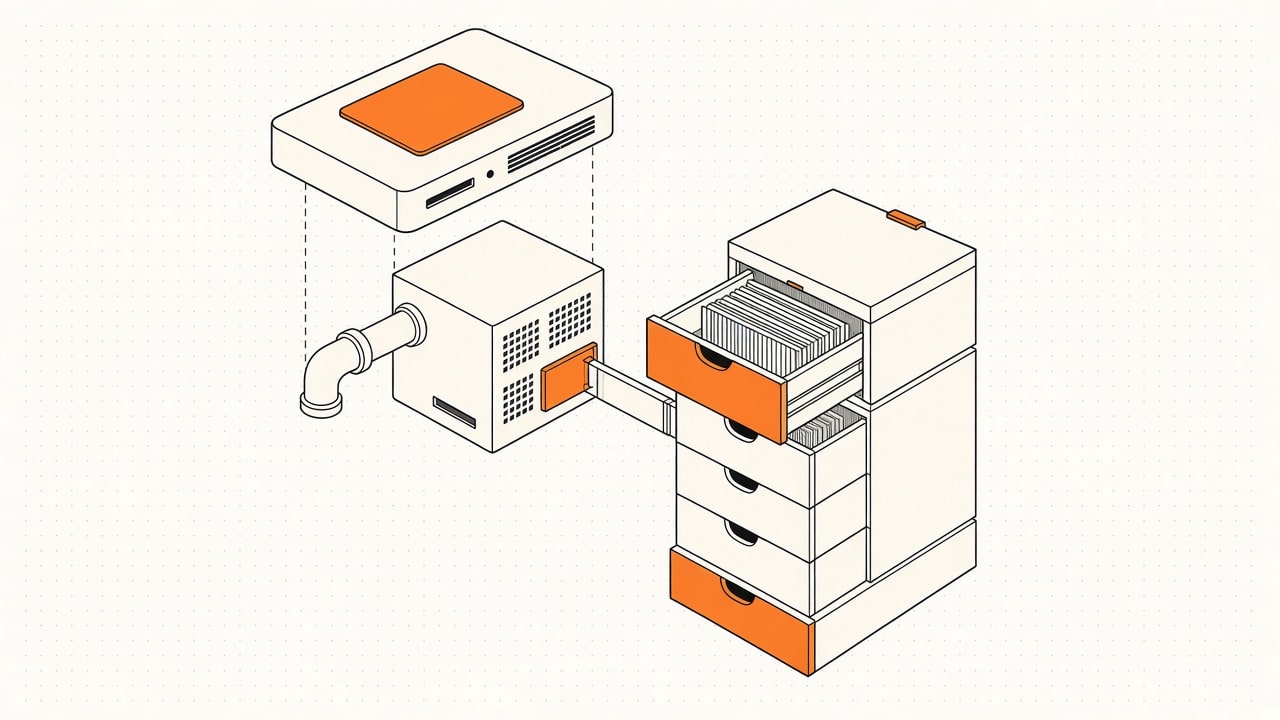
Most teams that ask me about the fine-tuning vs RAG decision matrix have quietly already chosen fine-tuning. The reasoning is always the same: we have company knowledge, the model does not have it, so we should teach the model. That instinct is wrong for the vast majority of small business projects, and the mistake is expensive, because the failure looks like progress for the first month.
The decision matrix below exists to settle the argument in an afternoon rather than after a five-figure training run. It separates the two things people confuse: teaching a model how to behave, and giving it knowledge it can look up. RAG handles the second. Fine-tuning handles the first. Projects that pick one architecture for both jobs stall.

If you have already decided fine-tuning is required, the practitioner guide to fine-tuning open source LLMs for business covers the mechanics. For the retrieval side, start with building a RAG system on your own knowledge base and the implementation details of hybrid search in PostgreSQL with pgvector. If you need the spending argument for a founder or finance lead, the AI ROI framework covers the numbers.
When Should a Small Business Choose RAG Over Fine-Tuning?
Retrieval is the default when the answer lives in documents. The model reasons over passages that were fetched at query time, so the knowledge stays in a database you already control and can update with a single row write.
Answer these five questions in order. The first one that fails tells you what to build.
- Does the answer depend on data that changes? Prices, policies, inventory, staff assignments, contracts. If yes, retrieval wins by default, because in retrieval an update is a database write and in fine-tuning an update is a new training run and a redeploy.
- Do you need to show your work? Support, legal, compliance, and finance users need a citation that points at a specific document version. Retrieval returns the chunk it used. A fine-tuned model returns fluent text with no provenance, and in a dispute that is worth nothing.
- Is the knowledge per-customer or per-tenant? A retrieval index can be filtered by tenant or permission group so one customer never sees another’s documents. Fine-tuning bakes every example into shared weights, and you cannot un-teach one customer’s data without retraining.
- Does the work reward recall or behavior? Recall: answering “what does our refund policy say” across 4,000 documents. Behavior: always answering in the same tone, in the same JSON shape, refusing the same requests. The first is retrieval. The second is fine-tuning.
- Does a twenty-query prompt prototype already pass? Put the twenty hardest real questions into a system prompt with five examples and measure. If the pass rate clears your bar, spend the budget on the product instead of the training pipeline.
The honest summary: if the knowledge is the product, retrieve it. If the behavior is the product, train it. Most small business projects are the first kind, which is why retrieval is the cheaper default.
What Fine-Tuning Actually Does Well
I keep seeing fine-tuning described as a way to add knowledge. It is not, at least not reliably. Published work on retrieval-augmented generation and the practical failure modes from teams that tried both put the split plainly: parameter updates change distributional behavior, not a durable fact store. Ask a model fine-tuned on your PDFs for the exact effective date of a policy and it will produce a plausible date.
Where fine-tuning earns its cost:
- Output format under strict constraints. A small open-weight model can be trained to emit a fixed schema every time, which removes long system prompts and the retry loops that come with them. This is the highest-return use case in production today.
- Tone and voice. Support replies in a house voice, clinical summaries in a regulated register, or a brand personality that a prompt keeps drifting away from.
- Classification and extraction. Routing tickets, tagging documents, extracting fields from invoices. Narrow task, measurable accuracy, cheap to evaluate.
- Distillation for cost and latency. Train a small model on outputs from a large one for a narrow task, then serve the small model. The win is per-call cost and latency, not capability.
- Domain syntax. A proprietary query language, an unusual file format, or a legacy dialect that the base model has never seen.
LoRA and QLoRA made this affordable, since you adapt a small set of adapter weights instead of the full model (the LoRA paper is the reference). It is still a machine learning project with a training set, a validation split, and an evaluation harness. Budget for that work honestly.
What Are the Real Costs of Fine-Tuning Versus Hosting a RAG Pipeline?
The expensive part of fine-tuning is not the GPU bill. It is the humans who produce verified input and output pairs.
| Line item | Fine-tuning | RAG |
|---|---|---|
| Data preparation | 1,000 to 10,000 human-verified pairs, typically $15,000 to $50,000 in labor | Chunking and metadata, often 1 to 2 weeks of engineering |
| One-time compute | $500 to $5,000 per training run, and several runs are normal | One embedding pass over the corpus |
| Embedding spend | Not applicable | A 200,000-chunk corpus at current embedding prices is a few dollars, not a budget item |
| Serving | Dedicated endpoints commonly $300 to $1,500 per month, or self-hosted GPU | Per-token inference, plus a database |
| Storage | Model artifacts and adapters, negligible | Vector index in memory, roughly 6 KB per 1,536-dimension chunk |
| Cost of one knowledge update | A new curated batch, another run, another deploy | One database write |
| Evaluation burden | Every retrain needs a regression harness | Retrieval quality plus answer quality |
Those ranges are planning numbers, not quotes. GPU and token prices move every quarter, and dedicated endpoint pricing varies by provider and by model size. The structural point survives the price changes: fine-tuning front-loads five figures of labor into a system whose knowledge goes stale, and retrieval defers cost until you actually serve traffic.

The update line is the one that kills fine-tuning projects. A policy that changes quarterly means four retraining cycles a year, four evaluation passes, and four deploys, forever. Retrieval handles the same change with an UPDATE.
Can Prompt Engineering Achieve the Same Results as Model Fine-Tuning?
Often, yes. This is the step teams skip, and skipping it is how they end up with a training pipeline they did not need.
Current foundation models accept context windows from 128,000 to over 1,000,000 tokens. That is enough to include an operations manual, a policy set, or thirty worked examples in the prompt itself. Prompting beats fine-tuning when the requirement is:
- Tone and persona, which a well-written system prompt establishes on the first try.
- Output shape, when five to ten examples plus a schema definition are enough to hold the format.
- Boundary setting, such as what the assistant must refuse and how it should phrase a refusal.
Prompting stops being enough in three situations. The context you need does not fit, or the cost of re-sending it on every request becomes the dominant line in your bill. The model drifts on format despite examples when the task is narrow and repeated millions of times. Or the task requires a capability a smaller, cheaper model can only reach after training.
The Five Question Decision Matrix
Score each question from 1 (strongly retrieval) to 5 (strongly fine-tuning), multiply by the weight, and add the total. The weighted sum runs from 12 to 60.
| Question | Score 1 looks like | Score 5 looks like | Weight |
|---|---|---|---|
| How often does the knowledge change? | Daily or weekly | Static for six months or more | 3 |
| Do answers need citations or audit trails? | Yes, always | No, style matters more than source | 3 |
| Does the task recall facts or shape behavior? | Recall over documents | Behavior, format, tone, classification | 2 |
| Is there curated input and output data? | No, just documents | Thousands of verified pairs | 2 |
| What does the budget support? | Under $5,000 to start | $25,000 or more for a training project | 2 |

Read the total as a starting position, not a verdict:
- 12 to 24. Retrieval. Build the index, tune retrieval, and revisit fine-tuning only if format complaints persist.
- 25 to 36. Hybrid. Retrieval for facts, and cheap prompt or adapter work for format.
- 37 to 60. Fine-tuning is defensible. Still build the evaluation harness before the first training run.
One dimension can override the score: if the knowledge must be deletable per customer for privacy or regulatory reasons, retrieval is the only option that deletes cleanly. Removing a record from a fine-tuned model means retraining.
The Hybrid Most Teams End Up With
Mature systems stop treating this as a binary. They fine-tune a small model for form and retrieve the facts into its context at query time.

The pattern that holds up: a retrieval step fetches eight to twelve chunks for the question, a reranker reorders them, and a model with a constrained output schema composes the answer with citations. The fine-tuned part, when it exists, is a small adapter that enforces the output schema and the house tone so the prompt can stay short. Cost per answer stays predictable because the expensive model is not re-reading a manual on every call.
How Do You Measure Whether It Worked?
Whichever path you take, the measurement plan is the same and it is not optional.
Build a golden set of 50 to 100 real questions from your users, each with the acceptable answer and, for retrieval, the document that contains it. Then track four numbers:
- Answer correctness. Share of golden questions answered within the acceptable set, judged by a human for the first pass and spot-checked after.
- Citation accuracy. For retrieval systems, whether the cited passage actually supports the claim. Retrieval can retrieve the right document and still produce an unsupported sentence.
- Cost per correct answer. Total monthly spend divided by correct answers, not by queries. This is the number that exposes a system that looks cheap until you count retries.
- p95 latency. Long context and reranking both show up here.
Run the same harness against a prompt-only baseline, a retrieval build, and, if you get that far, a fine-tuned build. If the retrieval build does not beat the prompt baseline on your golden set, you have a retrieval problem, not a training problem, and no amount of fine-tuning will fix the ranking underneath it.
Five Failure Modes I See Repeatedly
| Symptom | Real cause | Fix |
|---|---|---|
| Fine-tuned model invents policy dates | Facts were trained instead of retrieved | Move the facts to retrieval, keep the format adapter |
| Retrieval answers sound correct but cite the wrong page | Chunking splits the answer from its heading | Chunk with headings attached, then rerank |
| Costs climb every month with flat usage | Long context re-sent per request | Retrieve fewer, better chunks and cache the static instructions |
| Model ignores the output schema on long inputs | Prompt-only format enforcement under strain | Constrain with structured output validation first, adapter second |
| Retrieved documents inject instructions | Retrieved text is untrusted input | Keep retrieved content out of instruction position and validate tool calls |
That last row is not hypothetical. Any pipeline that puts third-party documents in front of a model inherits the document’s instructions as a risk, which is the same class of problem covered in prompt injection attacks and how to protect against them.
A 30-Day Plan to Decide and Ship
- Week one: define the twenty questions. Pull real user questions, write the acceptable answers, and build the harness. This is the deliverable that makes every later argument factual.
- Week two: prompt baseline. Frontier model, system prompt, five examples, whatever context fits. Record correctness, latency, and cost per answer.
- Week three: retrieval prototype. Chunk the corpus, embed it, and serve the same twenty questions with citations. Compare against the baseline on the same harness.
- Week four: decide with numbers. If retrieval clears the bar, ship it and revisit format issues with a small adapter. If the gap is specifically format or tone that prompting cannot hold, price the training project with the labor line included, and only then commit.
Conclusion
The fine-tuning versus RAG decision is not a matter of taste or model fashion. It comes down to whether your product’s value is knowledge, which you should retrieve, or behavior, which you can train. Teams that confuse the two spend five figures to teach a model facts it cannot reliably keep, or spend months prompting a model to hold a format it keeps drifting from.
Score the matrix, run the twenty-question test, and let the numbers make the argument. The cheapest architecture is always the one that matches the job, and for most small businesses that means an index, a reranker, and a short prompt.
Unsure whether to build RAG or fine-tune for your business?
Veduis helps small businesses, startups, and software engineering teams evaluate AI architecture feasibility, build scalable RAG pipelines, and prevent costly cloud overspend.