
I have spent the last year wiring Model Context Protocol (MCP) into small business stacks. Most owners do not care about the protocol itself. They care that their AI assistant can finally read the CRM, update a spreadsheet, and file an invoice without someone copying and pasting between six tabs. That is what MCP delivers when you set it up correctly. This guide shows you how to do that in 2026 without hiring a research lab.
What MCP Actually Is (and What It Is Not)
MCP is an open standard that lets an AI model talk to external tools through a single, consistent interface. Anthropic proposed it in late 2024, and by December 2025 it moved under the Linux Foundation’s Agentic AI Foundation with backing from OpenAI, Google, Microsoft, and Block. The goal is simple: build one connector for your tool, and any MCP-compatible AI can use it.
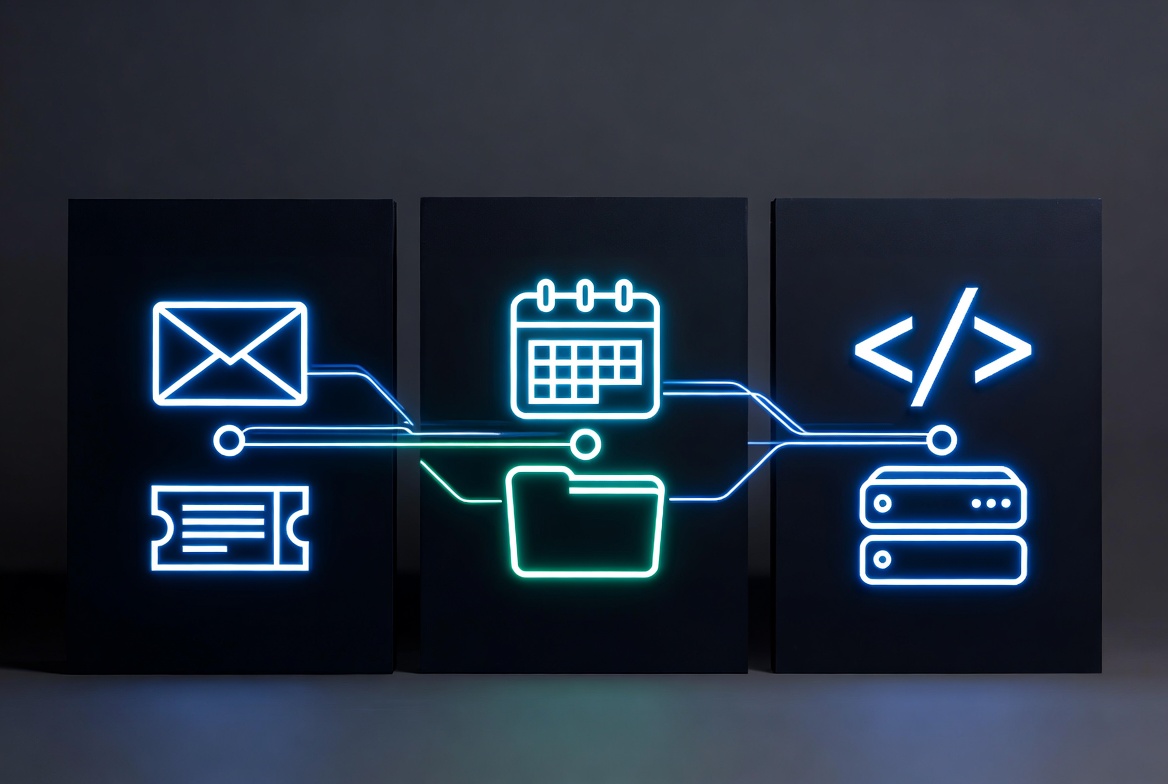
Think of it like a USB-C port for AI. Before MCP, every model had its own proprietary plug. If you wanted ChatGPT, Claude, and Gemini to all read your HubSpot data, you built three separate integrations. With MCP, you build one HubSpot MCP server and every supported model can call it. The official Model Context Protocol documentation explains the technical details, but the business takeaway is portability and reduced integration cost.
MCP is not a magic button. It does not replace your CRM, your workflow automation, or your judgment. It gives your AI model hands. You still need to decide what those hands are allowed to touch.
The 2026 Tool Stack: Models, Servers, and Automation Platforms
The model layer in mid-2026 has four serious options. I have tested all of them against real business tasks.
Claude Opus 4.8 is the strongest agentic worker as of May 2026. It leads on MCP-Atlas, which measures MCP tool orchestration, and scores 69.2% on SWE-bench Pro. Pricing is $5 per million input tokens and $25 per million output tokens. It is my default for complex multi-step work.
GPT-5.5 released April 23, 2026, and is excellent for terminal work, coding, and broad tool support. OpenAI’s Responses API guide now treats MCP as a first-class citizen. Pricing is $5 per million input tokens and $30 per million output tokens, with a cheaper GPT-5.4 tier at $2.50/$15 if your tasks are simpler.
Gemini 3.1 Pro is the price-performance pick. At $2 per million input tokens and $12 per million output tokens for prompts under 200K, it undercuts Claude and GPT by roughly half. Use it for high-volume work where every token matters.
GLM-5.2 is the open-weights challenger. At $1.40 per million input tokens and $4.40 per million output tokens, it is the cheapest option that still competes on agentic benchmarks. If you want to self-host and control your data, this is worth evaluating.
For automation platforms, the three names that keep coming up are n8n, Make.com, and Zapier. In 2026, n8n 2.0 ships native MCP nodes, 70+ AI nodes, and self-hosted deployment. A 10-node workflow running 10,000 times costs roughly $24 per month on n8n Cloud versus about $370 on Zapier because Zapier bills per task while n8n bills per workflow execution. Make.com sits in the middle with strong visual branching and an official MCP server that lets Claude build and modify scenarios through conversation.
I usually recommend n8n for technical teams, Make.com for teams that want visual power without infrastructure, and Zapier only when the team has no technical bandwidth and low volume.

Three Small-Business Use Cases That Pay Back Fast
I do not recommend starting with five use cases at once. Pick one where the ROI is obvious and the integration is light. Here are three I have deployed repeatedly.
Customer support triage. An MCP-connected assistant reads incoming tickets from Zendesk or Intercom, checks the customer’s purchase history in Stripe or Shopify, searches your internal knowledge base, and either drafts a reply or routes the ticket. I have seen 30 to 50% ticket deflection in the first 60 days. This pairs cleanly with the approach in our AI customer service solutions for small businesses post.
Sales meeting follow-up. After a call, the assistant pulls the transcript, reads the CRM record, checks the calendar for next steps, and drafts a personalized follow-up email with the right collateral attached. Reps typically save six to eight hours per week on follow-up work. The workflow is low risk because it drafts rather than sends until a human approves it.
Development workflow helper. For product teams, MCP can run code review, check Jira tickets, query logs, and update documentation. Claude Opus 4.8 shines here. I have seen code review turnaround drop by 35 to 40% when the agent is wired to GitHub and the issue tracker correctly. We cover similar patterns in our guide to AI-assisted development workflows.
Each of these uses two to four MCP servers. They are not science projects. They are narrow, measurable workflows that free up human time.
Pricing Reality Check
Small business owners ask me one question first: what does this actually cost? Here is the honest math.
A typical support triage agent might consume 2,000 input tokens and 400 output tokens per ticket. At Claude Opus 4.8 rates, that is about $0.02 per ticket. If you handle 1,000 tickets per month, the model spend is roughly $20. Add the platform cost: n8n Cloud Pro at $50 per month or Make.com Core at about $10 per month. Your total monthly AI layer is under $100, and you are deflecting hundreds of tickets.
Compare that to adding another support rep.
For development workflows, the math changes because Opus 4.8 tasks burn more tokens. A 50K input / 10K output coding session costs about $0.50. Run 50 of those per week and you are looking at $100 per month in model costs. That still beats the salary equivalent of one senior engineer hour.
The hidden cost is retries. Agentic workflows do not always succeed on the first attempt. Budget 20 to 30% overhead for failed or repeated tool calls during your first month. After that, your prompts and tool schemas stabilize and costs flatten.

Security and Governance Pitfalls I’ve Seen
MCP is powerful because it gives models access to real systems. That is also why it can go wrong. I have seen three mistakes repeatedly.
Over-permissioning the first server. A business hooks up their Postgres MCP server with full read-write access, and two weeks later an agent deletes a row it should not have touched. Start with read-only access. Add write scopes one at a time, each with explicit approval gates.
Ignoring the April 2026 security advisory. OX Security disclosed that Anthropic’s official MCP SDKs passed command strings directly to subprocess without sanitization, exposing an estimated 200,000 servers. The issue is not a reason to abandon MCP, but it is a reason to keep your SDKs updated, sandbox MCP processes, and only install servers from sources you trust. The NIST AI Risk Management Framework is a useful reference for mapping these risks.
Running agents without audit logs. If an AI updates a CRM record or processes a refund, you need to know who asked it to and what changed. Use platforms that log every tool call, and review those logs weekly until the workflow is stable.
Governance separates a useful MCP deployment from a liability.

How to Start Without Wasting Money
Here is the rollout I recommend for a 5-to-50-person business.
Week one: install one read-only MCP server in Claude Desktop or n8n. A filesystem server or a Google Drive server is a safe starting point. Ask the assistant a simple question that requires reading data, then verify the answer.
Week two: add your first operational tool. For most businesses, that is either a CRM connector or a support ticket connector. Keep it read-only. Measure how many queries the assistant answers correctly before a human intervenes.
Week three: enable a single write action behind human approval. Examples include drafting a follow-up email, updating a deal stage, or creating a calendar event. Never let the agent write without confirmation until you have logged at least 50 correct reads.
Month two: add a second use case only if the first one is stable. If it is not stable, fix the prompts, permissions, or tool schemas before scaling. MCP failures are almost always integration failures, not model failures.
Month three: evaluate cost and ROI. If you saved more labor than the tool spend, expand. If not, kill the use case and try a different one. For more complex multi-step patterns, our post on AI agent orchestration for multi-step workflows walks through the architecture.
If you want a curated list of MCP servers and compatible tools, browse the MCP server collection on VePrompts. It saves time versus digging through GitHub registries.

Conclusion
MCP is not a buzzword. In 2026, it is the practical standard that lets small businesses connect AI models to the tools they already pay for. The winners are not the companies that deploy the most agents. They are the companies that pick one narrow workflow, wire it cleanly, measure the result, and only then add the next one.
Start with read-only access. Pick Claude Opus 4.8 for complex agentic work, Gemini 3.1 Pro for cheap high-volume tasks, or GLM-5.2 if you need self-hosted control. Pair your model with n8n if you have technical staff, Make.com if you want a visual builder, or Zapier if you need the simplest start. Keep logs, review permissions, and treat the first month as an experiment with a budget cap.
The small businesses I work with that get this right usually see a positive return within 30 days on their first use case. The ones that get it wrong try to automate everything at once and wonder why their AI keeps breaking things. Choose the first path.