On October 20, 2026, NVIDIA quietly published a new open-source repository under the Apache 2.0 license: flare-local-inference. With no press release and initial single-digit GitHub stars, the project caught the attention of local AI researchers and systems engineers tracking Blackwell workstation deployments.
The engine, codenamed Flare, is not another generic model runner. It is a specialized, hardware-co-designed local inference server built specifically for NVIDIA SM120 and SM121 architectures. These instruction set targets power the RTX PRO 6000 Blackwell workstation cards, mobile Blackwell silicon, and compact desktop AI supercomputers like the NVIDIA DGX Spark, which pairs Grace CPU cores with 128GB of unified LPDDR5x memory.
Flare tackles the primary failure mode of local AI development: running long-context coding agents, iterative tool-use chains, and recursive reasoning loops on workstation hardware without running out of memory or stalling on Python runtime overhead.
The Problem With Generic Inference Engines on Workstations
Over the past three years, vLLM established itself as the gold standard for data center LLM serving, while tools like Ollama and llama.cpp democratized consumer desktop execution. However, serving autonomous coding agents on dedicated developer workstations exposes severe architectural bottlenecks in both approaches:
- The Broad Compatibility Tax: Engines like vLLM must support hundreds of hardware variants: NVIDIA Hopper, Ampere, Ada Lovelace, AMD ROCm, Intel Gaudi, and AWS Inferentia. Maintaining this vast matrix requires abstraction layers across memory managers, communication primitives, and kernel schedulers. Those abstractions prevent tight coupling with specialized memory features on newer silicon.
- The Python Serving Tax: Most serving engines run their orchestration loop inside Python. While Python is unmatched for model research and kernel development, running high-concurrency request scheduling, token streaming, and cancellation handling inside a Python runtime introduces global interpreter locks, unpredictable memory allocators, and CPU scheduling jitter.
- The Agent Context Expansion Trap: Autonomous developer agents, such as those analyzed in our overview of local LLMs versus cloud AI for business, do not make short, single-turn requests. They make hundreds of sequential calls, appending tool execution outputs, compiler errors, and modified code blocks to an expanding context window. Without unified prefix caching, losslessly compressed scales, and strict memory budgeting, the Key-Value (KV) cache quickly exhausts available GPU memory.
Flare rejects broad hardware portability. Instead, it concentrates entirely on Blackwell-era desktop and workstation hardware, trading generic compatibility for extreme hardware efficiency.
Core Architectural Separation: Ignition vs. Helios
Flare resolves the tension between Python machine learning development and high-performance systems engineering by enforcing a strict physical separation between build time and serve time.
The project is split into two distinct sub-systems: Ignition (the Python preparation engine) and Helios (the native Rust serving runtime).
+--------------------------------------------------------------------------+
|                       BUILD TIME: IGNITION (Python)                      |
|                                                                          |
|  [Hugging Face / Local Weights] -> [PyTorch & Transformers]             |
|                                    |                                     |
|                                    v                                     |
|                       [b12x / FlashInfer Kernels]                        |
|                                    |                                     |
|                                    v                                     |
|                    [torch.compile Forward Execution]                     |
|                                    |                                     |
|                                    v                                     |
|                  [CUDA Graph Capture & Warmup Variants]                  |
|                                    |                                     |
|                                    v                                     |
|          [Runtime Package: .safetensors Metadata + SHA-256 Blobs]        |
+--------------------------------------------------------------------------+
                                     |
                                     | (Zero Python at Runtime)
                                     v
+--------------------------------------------------------------------------+
|                        SERVE TIME: HELIOS (Rust)                         |
|                                                                          |
|  [HTTP Ingress: OpenAI / Anthropic API] -> [Bounded Request Scheduler]  |
|                                            |                             |
|                                            v                             |
|                           [Caller-Owned Page Pool]                       |
|                          (FP8 KV Cache + CSF Scales)                     |
|                                            |                             |
|                                            v                             |
|                      [Direct CUDA Graph Replay Engine]                   |
|                                            |                             |
|                                            v                             |
|                        [Streaming SSE Token Delivery]                    |
+--------------------------------------------------------------------------+
1. Build Time: Ignition in Python
Model research and architecture definitions live in Python. Attempting to rewrite every Hugging Face tokenizer, weight conversion script, and quantization formula into a compiled language results in an endless maintenance burden.
Ignition embraces Python where it excels. Using PyTorch, Hugging Face Transformers, and the b12x compute library within FlashInfer, Ignition loads model weights, tunes kernels for the specific host GPU, composes model forwards, and compiles them using torch.compiler.
Crucially, Ignition executes full forward warmups and captures static CUDA graphs for all supported batch sizes and sequence buckets. Once captured, Ignition serializes the compiled modules, allocation plans, memory maps, and tokenizers into a unified Runtime Package.
A runtime package consists of a metadata primary file (.safetensors) containing a signed Protobuf envelope, paired with immutable, content-addressed payload blobs named by their SHA-256 hashes. These blobs hold the compiled CUDA modules, tensor weights, and pre-computed graph layouts. Once exported, Python exits completely.
2. Serve Time: Helios in Rust
Helios is a pure Rust binary and shared library. It contains zero Python dependencies, zero CPython bindings, and zero runtime interpreters.
When launched, Helios memory-maps the runtime package blobs directly into pre-allocated GPU and host buffers. Because all CUDA graphs, kernel configurations, and memory layouts were pre-calculated during the Ignition step, Helios acts as an ultra-low-latency deterministic dispatcher:
- It validates incoming HTTP requests.
- It allocates execution slots from a bounded, pre-sized page pool.
- It replays pre-captured CUDA graphs directly against GPU streams.
- It streams generated tokens back through standard Server-Sent Events (SSE).
By shifting all compilation, graph generation, and shape planning into an upfront build step, the serving path achieves predictable sub-millisecond dispatch times with zero memory allocation churn.
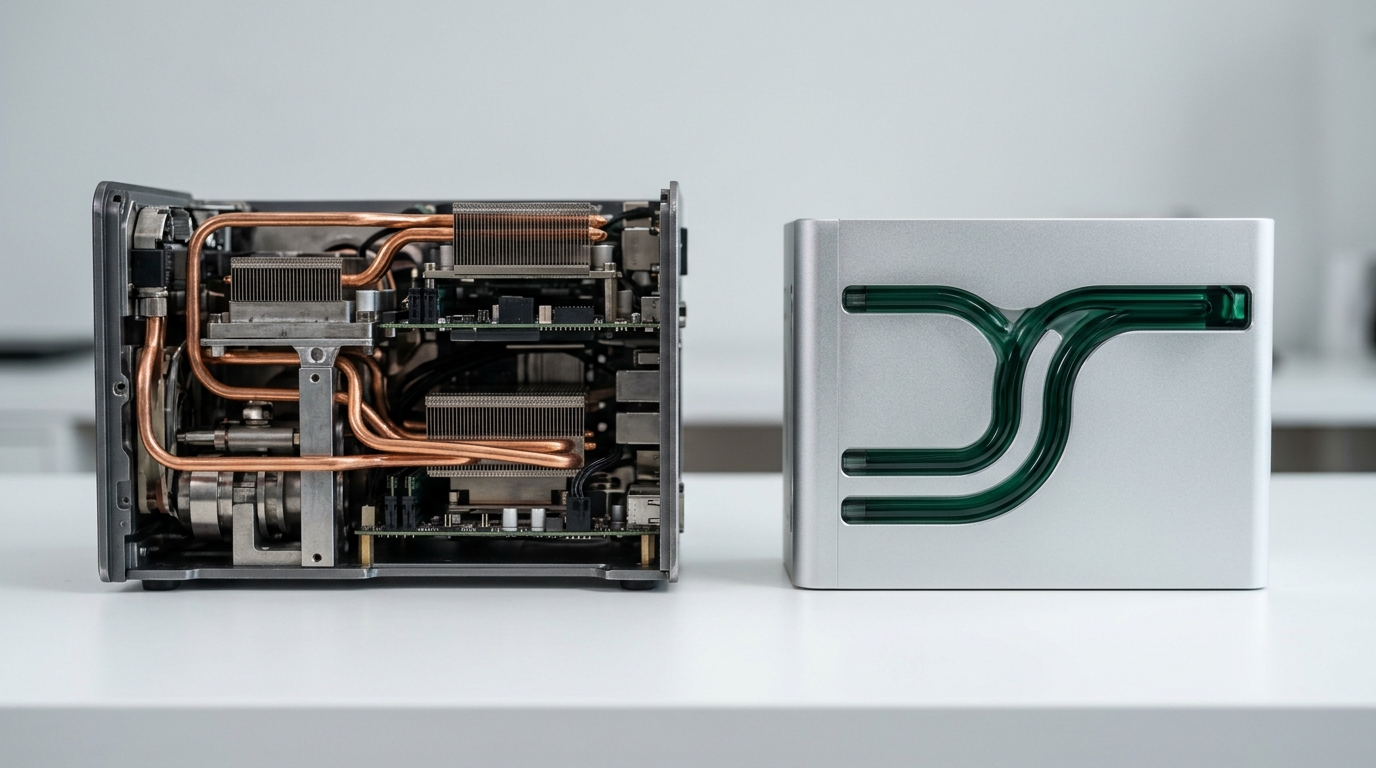
Key Technical Innovations in Flare
To understand why Flare achieves responsive generation on long contexts, we must look at the specific low-level mechanisms implemented across the stack:
1. Lossless Scale Compression (CSF) and FP4 Quantization
Flare is built around quantized QAD (Quantization-Aware Distillation) model checkpoints utilizing losslessly compressed FP4 scales stored in the Compressed Scale Format (CSF).
In standard FP4 or INT4 implementations, the scaling factors required to dequantize weights consume substantial GPU memory bandwidth. CSF keeps scale metadata compressed directly in memory between forward passes. Individual model layers reuse shared expansion scratch buffers during execution, significantly lowering the resident VRAM footprint of 70B+ parameter checkpoints.
2. Native FP8 KV Caching by Default
Every model recipe in Flare defaults to FP8 E4M3 Key-Value cache storage. This applies to both the primary generative model and auxiliary draft models used in speculative decoding.
By storing KV activations in FP8 rather than standard 16-bit floating point (BF16 or FP16), the memory required to maintain long conversational histories is cut by 50%. On a workstation with 64GB or 128GB of unified memory, this allows an engineer to maintain context windows exceeding 64,000 to 128,000 tokens while keeping multi-request concurrency active.
3. Unified Continuation State and Deep Prefix Caching
Most inference engines treat KV caches as disposable page blocks. Flare treats conversation state as a persistent, unified whole. This includes not only standard self-attention KV caches, but also recurrent state matrices (such as those used in linear attention or state-space layers), compressor accumulators, and hidden activations.
When an autonomous coding agent executes a bash command or reads a repository file, the conversation history shares a long static prefix with the previous prompt. Helios automatically identifies matching prefixes and retains them in the GPU page pool. Because memory is explicitly managed by the Rust scheduler, cached prefixes survive across branching turns without triggering cache invalidation or memory fragmentation.
For developers building reliable multi-agent workflows, pairing persistent prefix caching with our architectural patterns for structured outputs and function calling ensures schema-valid tool execution without paying redundant prefill compute costs on every loop.
4. Native Multi-Protocol API Support
A major frustration for software engineers deploying local inference engines is API incompatibility. Some tools only support raw text completions, others require OpenAI-format wrappers, while modern agent frameworks increasingly demand Anthropic-style message structures.
Helios solves this by implementing native, multi-protocol ingress directly inside the Rust HTTP server:
| Endpoint | Ingress Format | Output Type | Primary Use Case |
|---|---|---|---|
POST /v1/chat/completions | OpenAI Chat format | JSON / SSE chunks | General LLM applications, LangChain, LlamaIndex |
POST /v1/messages | Anthropic Messages API | Message blocks / SSE events | Claude Code, Cursor, Cline, OpenHands |
POST /v1/messages/count_tokens | Anthropic request payload | Exact input token count | Pre-flight token budgeting and agent context planning |
POST /v1/responses | OpenAI Responses API | Ordered items / SSE events | Next-generation structured agent loops |
POST /v1/completions | Raw prompt or token IDs | Raw token completions | Base model evaluation and synthetic dataset generation |
This multi-protocol design allows developers to point Claude-oriented tools like Cline directly at their local Flare instance without requiring intermediary proxy servers like LiteLLM.
Supported Models and Production Recipes
Rather than attempting to support every model architecture on Hugging Face, Flare organizes model support into qualified, production-tested recipes located in ignition/recipes/. Each recipe declares pinned checkpoint revisions, supported tensor-parallel dimensions, memory cost formulas, and pre-tuned b12x kernel configurations.
The initial public release includes recipes for top-tier open-weight architectures:
- Nemotron 3.5 Bolt (74B-A9B): Prepared specifically for single-GPU 24GB VRAM execution (
nemotron-bolt-24gb). Employs aggressive FP4 scale compression and C-RADIO vision encoders for still-image reasoning. - DeepSeek (V3, R1, V4): Specialized recipes (
deepseek4anddeepseek41) supporting multi-head latent attention (MLA), native FP8 matrix multipliers, and packed scale formats. - Qwen (2.5 / 3.8 / 3.8 Dense): Supports single-GPU (TP1) and dual-GPU (TP2) tensor-parallel configurations with BF16 selector keys and FP8 KV caches.
- GLM and Kimi (K2.5): Recipes for long-context reasoning with packed latent representations and structured speculative decoding.
- StepFun Step-5: Specialized recipe for multi-token prediction and dense MoE execution.
Hands-On Implementation: From Checkpoint to Serving
Deploying an LLM through Flare follows a clear two-step sequence: preparing the runtime package with Ignition, then launching the service with Helios.
Step 1: Environment Preparation
Flare requires a modern Linux environment with the CUDA Toolkit (including nvcc and CUPTI), Python headers, and a Rust toolchain.
Install build dependencies on Ubuntu or Debian:
sudo apt-get update
sudo apt-get install -y gcc g++ make cmake ninja-build pkg-config \
    protobuf-compiler libssl-dev python3-dev liburing-dev
Clone the repository and set up the Python preparation virtual environment using uv:
git clone https://github.com/NVIDIA/flare-local-inference.git
cd flare-local-inference

# Install Python dependencies and preparation tools
uv sync --locked --extra prepare --extra test

# Build the native Rust serving CLI
cargo build --release --manifest-path flare/Cargo.toml
Step 2: Preparing a Model with Ignition
To export a model, run ignition export. Ignition downloads the base checkpoint, tunes the FlashInfer kernels, compiles the forward execution graphs, and packages the artifacts:
# Export Nemotron 3.5 Bolt for a single 24GB Blackwell GPU
.venv/bin/ignition export nemotron-bolt-24gb \
    --output ./packages/nemotron-bolt.safetensors \
    --gpus 0 \
    --compile-workers 16
During this step, Ignition runs detailed kernel tuning across candidate matrix shapes and captures CUDA graphs for all supported prefill and decode batch sizes.
Step 3: Launching the Native Helios Server
Once export finishes, launch the compiled Rust server. Notice that you point flare run directly at the .safetensors package file:
# Launch the native Rust inference server
./flare/target/release/flare run ./packages/nemotron-bolt.safetensors \
    --gpus 0 \
    --host 127.0.0.1 \
    --port 8000 \
    --max-concurrency 8
Helios starts instantly. There is no model loading delay, no JIT compilation phase, and no Python process running in the background.
Step 4: Connecting an Agent Client
Because Helios exposes standard API endpoints, you can connect your existing tools immediately. For example, using the standard OpenAI Python SDK:
from openai import OpenAI

client = OpenAI(
    base_url="http://127.0.0.1:8000/v1",
    api_key="local-dev-token"
)

response = client.chat.completions.create(
    model="nemotron-bolt-24gb",
    messages=[
        {"role": "system", "content": "You are a senior systems engineer."},
        {"role": "user", "content": "Analyze the memory bandwidth advantages of CUDA graph capture."}
    ],
    temperature=0.2,
    max_tokens=1024
)

print(response.choices[0].message.content)
If your toolchain connects to external model providers or hybrid cloud endpoints, our production guide on building an LLM router for multi-model architectures details how to route high-volume agent loops to your local Flare instance while falling back to cloud models for secondary tasks.
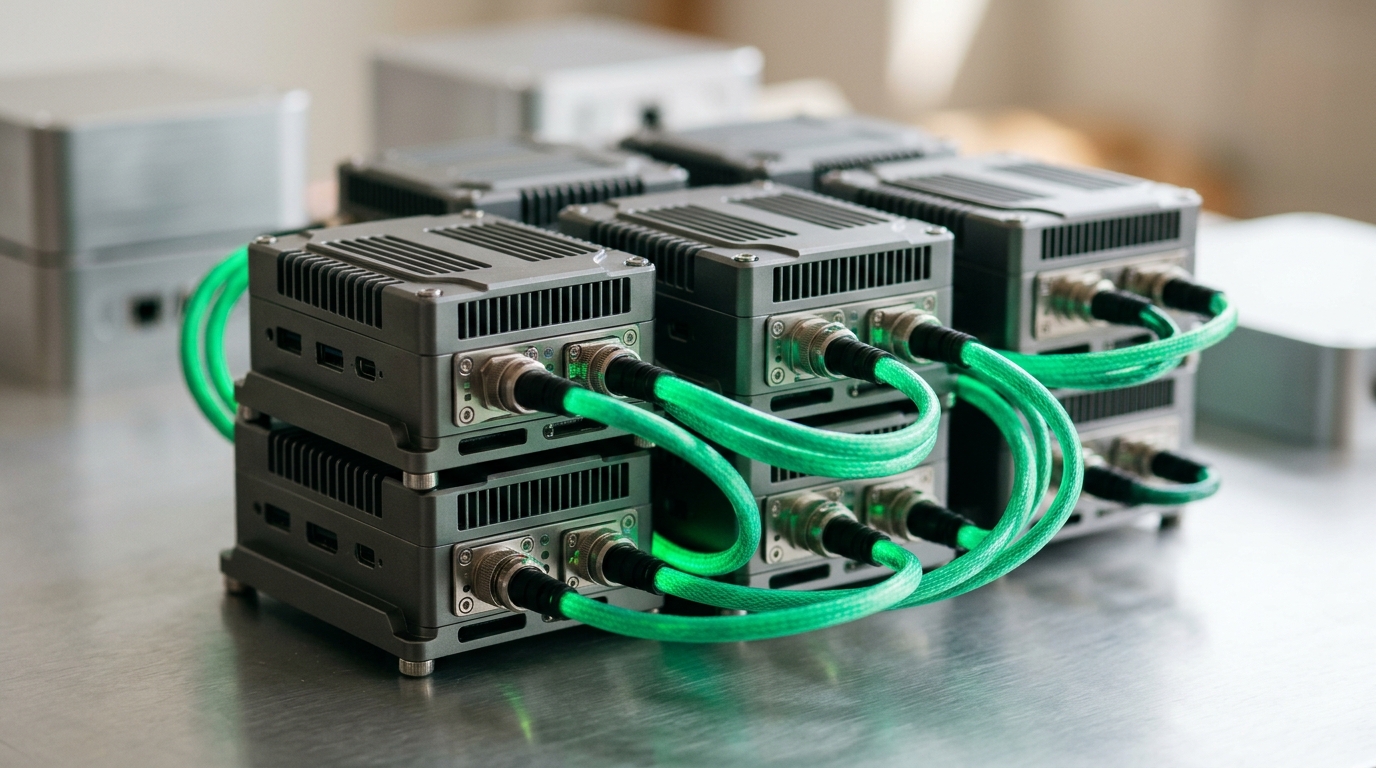
Distributed Local Inference: Flare Orbit
Workstations and compact servers like the DGX Spark often operate in small groups across a developer studio or research lab. Flare includes a built-in distributed clustering system called Orbit.
Orbit coordinates multiple machines over local networks without requiring heavy orchestration software like Kubernetes or Slurm:
- Pairing and Discovery: Nodes pair via mutual authentication keys using
flare orbit pair. - RoCE-Ring Networking: Orbit implements high-speed tensor parallelism over RoCE (RDMA over Converged Ethernet) ring topologies.
- Unified Cluster Launch: An engineer can dispatch a 4-way tensor-parallel model across four desktop workstations with a single command:
flare orbit run ./packages/deepseek-v3-tp4.safetensors \
    --cluster lab-workstations \
    --name deepseek-service \
    --persistent
This transforms scattered desk-side GPUs into a cohesive, high-speed distributed inference fabric.
If your team also operates custom developer tooling or local background daemons, reviewing our security protocols for MCP server security hardening outlines the network boundaries and token isolation required to keep local inference clusters secure from unauthorized network access.
What Flare Means for the AI Industry
NVIDIA Flare signals a significant strategic shift in how AI hardware manufacturers approach local inference:
- Hardware-Co-Designed Serving is the New Frontier: General-purpose inference engines served the early adoption phase of LLMs. However, as silicon architectures introduce specialized scale formats (FP4, CSF) and unified memory superchips, the software stack must be designed in lockstep with the memory bus.
- The Demise of Python in Production Serving: Python will always dominate model training and exploratory research. But Flare proves that serving belongs to native, compiled languages. Eliminating Python from the serving loop eliminates unpredictable garbage collection pauses, lowers CPU consumption, and unlocks true deterministic latency.
- Local Desktop Supercomputing for Coding Agents: By allowing models with 70B+ parameters to run responsively on compact systems like DGX Spark, developers gain fully private, unmetered, zero-latency execution environments. Software engineers can run autonomous agents continuously without incurring five-figure monthly API bills or transmitting proprietary intellectual property to third-party cloud vendors.
Summary
NVIDIA Flare is a masterclass in focused engineering. By deliberately narrowing its scope to NVIDIA SM120/SM121 GPUs, decoupling Python preparation from Rust execution, and enforcing strict caller-owned memory planning, Flare delivers what workstation AI developers have long demanded: responsive, long-context inference that squeezes every drop of compute from local silicon.
For engineering teams investing in Blackwell workstations or DGX Spark infrastructure, Flare represents the foundation of the next-generation local AI stack.