On October 21, 2026, coordinated security advisories disclosed a critical memory safety flaw residing in Google’s open source Brotli compression library. Cataloged as CVE-2026-111497 with a CVSS v4.0 score of 9.2, the defect is an out-of-bounds write vulnerability within the core C decompression routines. While initial threat intelligence tracked the vulnerability under the moniker Node2Shell due to high-profile proofs of concept against Node.js runtime environments, rapid telemetry analysis by security intelligence firms, including Aikido Security, revealed a far wider blast radius. The vulnerability has since evolved across the industry into HTTP2Shell.
[!CAUTION] Active Exploitation in the Wild & CISA KEV Inclusion (October 27, 2026) On October 27, 2026, the Cybersecurity and Infrastructure Security Agency (CISA) officially added CVE-2026-111497 to its Known Exploited Vulnerabilities (KEV) Catalog. Threat intelligence telemetry from honeypots (Akamai, GreyNoise, and Palo Alto Networks) confirms automated internet-wide scanning campaigns targeting unpatched APIs. Attackers are chaining initial memory disclosure primitives (to defeat ASLR) with crafted block-type-switch streams to gain remote execution. Edge WAF rules alone are insufficient; systems teams must immediately verify package versions and flush running process memory.
Because Google Brotli is the universal compression standard used across both HTTP/1.1 and HTTP/2 transport layers, any web server, API gateway, reverse proxy, or microservice decoding untrusted Brotli payloads (Content-Encoding: br) is exposed to heap corruption, process termination, and unauthenticated Remote Code Execution (RCE).
The discovery follows directly behind the recent PHP core emergency remediation incident (“PHP2Shell”), reinforcing an urgent operational reality: frontier AI reasoning models are systematically uncovering multi-year memory bugs in foundational internet infrastructure. In this case, researchers at OpenAI Codex Security, specifically Sylvie Mayer and Khai Tran, utilized advanced reasoning systems to identify the root parser flaw.
This technical guide provides systems architects, DevOps teams, and security engineers with a verified technical post-mortem: the C-level memory mechanics inside Brotli, the expanded scope across Node.js, Bun, Microsoft .NET, Python, and Envoy, step-by-step CLI fleet auditing commands, official package upgrades, and edge WAF rules to drop malicious compression payloads before they reach application workers.

1. Low-Level Technical Anatomy: The Brotli Decoder Flaw
To understand why HTTP2Shell bypasses high-level runtime protections like JavaScript sandboxes or Python type boundaries, you must examine how compression libraries operate inside memory space.
The defect resides in c/dec/decode.c inside Google Brotli versions 1.0.3 through 1.2.0, specifically within the internal state machine function DecodeBlockTypeAndLength.
The State Machine Confusion
Brotli utilizes complex prefix trees and Huffman codes to stream compressed data chunks without requiring the entire payload in memory upfront. During streaming decompression, DecodeBlockTypeAndLength parses incoming bitstreams to allocate block categories (literal, insert-and-copy, or distance codes) and determine the byte length of the upcoming data block.
The implementation flaw stems from overloaded return status semantics:
- Ambiguous Error Signaling: The internal decoder routines used boolean return values to signify two mutually exclusive states: a fatal syntax error in the compressed bitstream, or a non-fatal “needs more input” condition common in streaming network sockets.
- State Desynchronization: When processing maliciously malformed block headers containing conflicting tree descriptions,
DecodeBlockTypeAndLengthentered a corrupted state where it recorded a partial block header but failed to reset internal ring buffer indices. - The Out-of-Bounds Write (CWE-787): When the calling loop in
BrotliDecoderDecompressStreamreceived this unhandled error status, it treated the partial failure as a recoverable streaming pause. Upon receiving the subsequent chunk of the HTTP request body, the decoder calculated write offsets based on the corrupted ring buffer indices, writing attacker-controlled decompressed bytes outside the allocated output buffer boundary on the heap.
/* Vulnerability Pattern in c/dec/decode.c (Brotli <= 1.2.0) */
static BROTLI_INLINE BrotliDecoderErrorCode DecodeBlockTypeAndLength(
    int safe, BrotliDecoderState* s, size_t tree_type) {
  /* ... parsing prefix codes ... */
  if (!BrotliSafeReadBits(br, num_bits, &bits)) {
    /* Boolean failure overloaded: was this EOF or a malformed tree? */
    return BROTLI_DECODER_NEEDS_MORE_INPUT;
  }
  /* Corrupted internal state allowed execution to proceed without boundary check */
  s->block_length[tree_type] = block_length;
  s->block_type[tree_type] = block_type;
  return BROTLI_DECODER_SUCCESS;
}
In compiled production binaries, the heap area directly adjacent to the Brotli ring buffer contains internal runtime bookkeeping structures. In Node.js, this adjacent memory often holds V8 ArrayBuffer backing stores or libuv event loop handles. In Python C extensions, it holds PyObject headers. By meticulously calculating the byte overflow length, security researchers demonstrated that an attacker can overwrite function pointers or manipulate memory length descriptors to achieve arbitrary memory read and write capabilities, culminating in an interactive remote shell.
Unlike common network bugs that only trigger null-pointer dereferences or segmentation faults, CVE-2026-111497 provides the deterministic control necessary for practical exploitation.
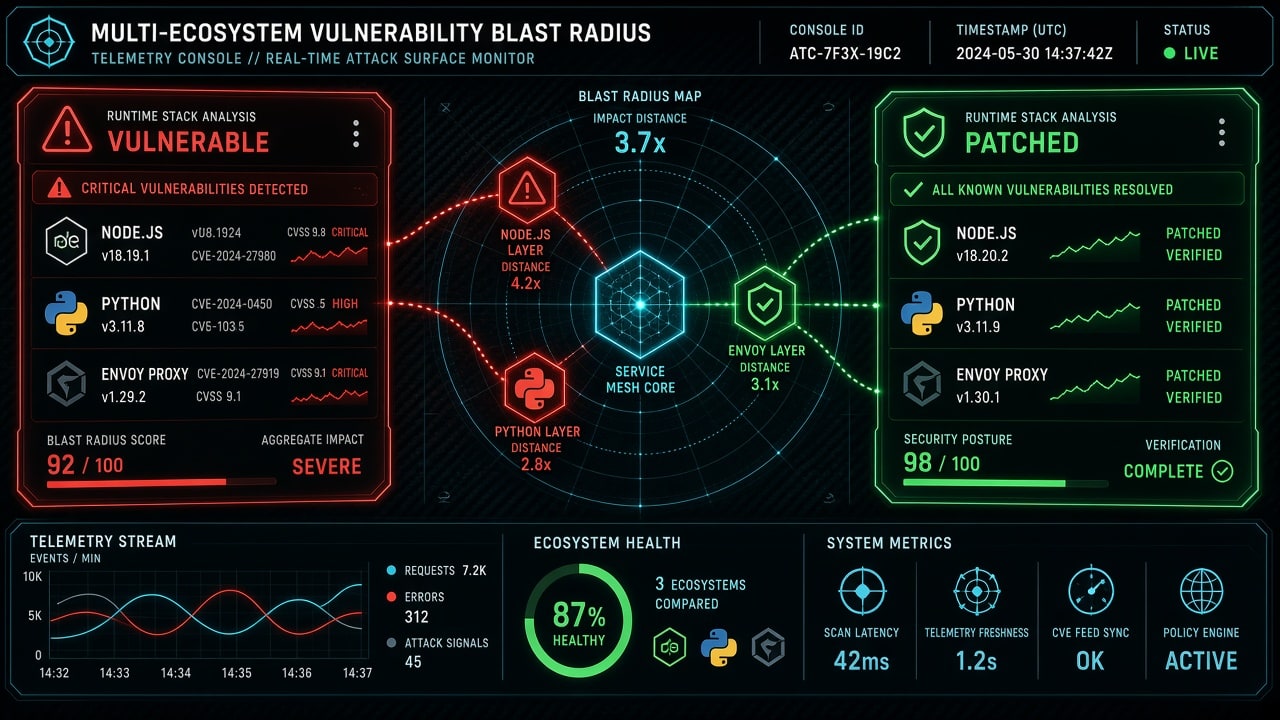
2. Blast Radius: Why Node2Shell Became HTTP2Shell
When the Imperva Red Team first verified code execution, they published findings demonstrating an exploit against Node.js web applications, giving rise to the name “Node2Shell.” However, isolating the flaw to Node.js misdiagnosed the architectural severity.
Google’s Brotli library is written in ANSI C. Because of its superior compression ratio compared to legacy Gzip, it has been embedded, vendored, or compiled into virtually every major language ecosystem and modern proxy layer over the past decade.
1. Node.js Runtimes & Web Frameworks
Node.js statically vendors Google Brotli into its internal zlib subsystem (node:zlib). Any Node.js application that receives compressed request bodies or fetches external data using Brotli is vulnerable:
- Incoming Requests: Frameworks using
body-parser, Express, Fastify, or NestJS with decompression enabled automatically callzlib.createBrotliDecompress()when an incoming request presentsContent-Encoding: br. - Outgoing Requests: Node.js native
fetch(), Undici, Axios, andgotautomatically advertiseAccept-Encoding: gzip, deflate, br. If an application queries an untrusted external API, a malicious server can reply with a crafted Brotli payload, achieving Remote Code Execution against the client application (SSRF weaponization).
2. Bun Runtime
Bun statically links native libraries for high throughput. Releases prior to Bun 1.4.4 vendored the affected Brotli decoder, making Bun HTTP servers and fetch clients equally susceptible.
3. Python Ecosystem
Python’s standard library does not bundle Brotli, but the broader data engineering and web backend ecosystem relies on two dominant C extensions:
brotli(official Google Python bindings)brotlicffi(used by urllib3, Requests, aiohttp, and Scrapy) Any FastAPI, Django, or Flask service utilizing ASGI/WSGI middleware to decode incoming Brotli request streams or scrape third-party web content inherits the out-of-bounds heap write.
4. Microsoft .NET and PowerShell (Emergency OOB Patches)
On October 25, 2026, Microsoft issued emergency out-of-band security advisories for the entire modern .NET platform (.NET 8.0, 9.0, 10.0, and 11 previews), PowerShell 7.4+, and Visual Studio. While legacy .NET Framework is immune because it relies on OS-level compression APIs, modern .NET compiles Google’s native Brotli decoder directly into System.IO.Compression.
A .NET service is exposed if it performs any of the following:
- ASP.NET Core Middleware: Services enabling request decompression via
builder.Services.AddRequestDecompression()andapp.UseRequestDecompression()automatically process incoming Brotli payloads. - Outbound HTTP Clients:
HttpClientinstances configured withAutomaticDecompression = DecompressionMethods.Brotliwill automatically decompress malicious server responses. - Direct Decoder Calls: Background queues or stream processors calling
BrotliStreamorBrotliDecoder.Decompress()on untrusted external data.
5. Edge Gateways, Service Meshes, and Proxies
While native Nginx core uses external gzip by default, popular third-party modules (ngx_brotli) and Envoy proxy filters decode or re-compress Brotli at the boundary. In microservice architectures where edge proxies or Istio sidecars decompress client requests before forwarding JSON payloads to internal services, the proxy itself becomes an exploit target. Similarly, Java microservices utilizing brotli4j and Go proxies wrapping C bindings inherit the same heap vulnerability.
If your infrastructure relies on modern reverse proxies, our analysis in Caddy vs Nginx in production details how different process isolation models affect runtime blast radiuses during protocol-level exploits.
3. Threat Vectors & Exploit Mechanics
Understanding the attack vectors allows systems engineers to deploy precise firewall rules while operating system updates are staged and tested.
+-----------------------------------------------------------------------------------+
|                           ATTACK VECTOR COMPARISON                                |
+-----------------------+-----------------------+-----------------------------------+
| Vector Category       | Entry Point           | Attack Mechanism                  |
+-----------------------+-----------------------+-----------------------------------+
| Ingress Request Body  | POST / PUT / PATCH    | Client sends Content-Encoding: br |
|                       | (API endpoints)       | to backend server middleware.     |
+-----------------------+-----------------------+-----------------------------------+
| Egress SSRF Response  | Outbound fetch / HTTP | Server fetches attacker payload;  |
|                       | (Webhooks, Crawlers)  | response returns crafted Brotli.  |
+-----------------------+-----------------------+-----------------------------------+
| HTTP/2 Frame Smuggle  | Multiplexed streams   | Small chunked DATA frames trigger |
|                       | (Edge proxies)        | fragmented state de-sync in heap. |
+-----------------------+-----------------------+-----------------------------------+
Vector A: Unauthenticated Ingress Request Ingestion
This is the most critical vector facing public APIs. Standard web architecture dictates that public clients can send JSON or form data compressed with Brotli if the server supports it:
POST /api/v1/telemetry HTTP/1.1
Host: api.target-system.com
Content-Type: application/json
Content-Encoding: br
Content-Length: 412

[Raw binary stream containing crafted Huffman tree structure...]
When the upstream server processes the body:
- Middleware inspects
Content-Encoding: br. - The runtime spawns a Brotli decompression stream.
- The crafted binary payload delivers an invalid tree definition that triggers the
BROTLI_DECODER_NEEDS_MORE_INPUTlogic bug. - Subsequent bytes overflow the heap, hijacking the thread of execution before application routing or token validation takes place.
Vector B: Egress Client Exploitation (Reverse Webhooks)
Enterprise SaaS platforms routinely fetch external URLs provided by users: webhook delivery verification, URL unfurling, OAuth metadata discovery, and PDF generation engines.
If your backend service issues an outbound request:
const response = await fetch(untrustedWebhookUrl);
const data = await response.json();
The underlying HTTP client advertises Accept-Encoding: br. The attacker’s server responds with HTTP 200 and Content-Encoding: br, delivering the exploit payload. The decompression occurs inside the client process memory, giving the attacker access to your internal backend network.
Vector C: HTTP/2 Stream Multiplexing and Frame Slicing
Under HTTP/2, request bodies are delivered across multiple independent DATA frames over a single TCP connection. Advanced threat telemetry confirms that attackers weaponize this transport mechanism to defeat perimeter defenses.
By slicing the malformed Brotli stream across tiny 9-byte to 16-byte DATA frames, attackers force the decoder state machine in c/dec/decode.c to yield BROTLI_DECODER_NEEDS_MORE_INPUT repeatedly across frame transitions. This deliberate fragmentation introduces two major operational challenges:
- Layer-7 WAF Inspection Bypass: Many edge proxies and Web Application Firewalls evaluate incoming HTTP/2 frames in streaming pass-through mode to preserve sub-millisecond latency. Because no single 16-byte chunk contains a recognized exploit signature, the fragmented payload traverses the perimeter unchallenged.
- Buffer Desynchronization in Reverse Proxies: When reverse proxies pass fragmented frames downstream to Node.js, Python, or .NET workers, the decoder consumes fragments incrementally. If an unbuffered proxy does not enforce complete stream reassembly before body processing, the corrupted ring buffer indices trigger an out-of-bounds heap write during mid-stream decoding.
For defense teams configuring reverse proxy inspection pipelines, our technical guide to Web Application Firewall fundamentals explains how full stream reassembly and protocol normalization prevent frame-slicing evasion. In environments where reverse proxies also protect CMS workloads, cross-vector scanning campaigns have been observed probing both HTTP/2 gateways and transient staging directories identified in our WordPress Core RCE Vulnerability Hardening Guide.
For developers seeking to strengthen client-side security baselines, our reference on web security fundamentals explains how process boundaries and sandbox configurations stop lateral escalation.

4. Phase 1: Fleet Inventory and Asset Discovery
Before applying updates or reloading services, you must audit your infrastructure to identify all instances of vulnerable Brotli decoders.
Step 1: Audit Node.js Runtimes Across Host Machines
Run the following command on your Linux hosts to verify the active Node.js binary and its bundled Brotli version:
node -e 'console.log({
  node: process.version,
  brotli: process.versions.brotli || "not bundled",
  vulnerable: ["22.23.3", "24.22.0", "26.12.0"].includes(process.version.slice(1)) ||
              (process.versions.brotli && process.versions.brotli <= "1.2.0")
})'
If the output reports vulnerable: true or indicates a Brotli version between 1.0.3 and 1.2.0, the runtime requires an immediate patch.
To find all secondary Node.js binaries installed on the host (e.g., via NVM, Volta, Docker, or system paths):
find / -name "node" -type f -executable 2>/dev/null | while read -r bin; do
  ver=$("$bin" -v 2>/dev/null || echo "unknown")
  echo "Found Node binary: $bin ($ver)"
done
Step 2: Audit Python Virtual Environments
Python applications often vendor Brotli C bindings inside isolated virtual environments. Search for vulnerable packages:
python3 -c '
import sys
for pkg in ["brotli", "brotlicffi"]:
    try:
        mod = __import__(pkg)
        ver = getattr(mod, "__version__", "unknown")
        print(f"[{pkg}] installed: version {ver}")
    except ImportError:
        print(f"[{pkg}] not installed")
'
Scan all active Python virtual environments on the filesystem:
find / -path "*/site-packages/brotli*" 2>/dev/nullStep 3: Inspect Running Processes and Shared Libraries
Verify which running processes have loaded the shared Brotli library (libbrotlidec.so) into active RAM:
lsof | grep -E "libbrotlidec\.so" | awk '{print $1, $2, $9}' | sort -uOn systemd-managed servers, query memory mapping for running web servers:
grep -l "libbrotlidec" /proc/[0-9]*/maps 2>/dev/null | cut -d/ -f3 | while read -r pid; do
  cmd=$(tr '\0' ' ' < "/proc/$pid/cmdline" 2>/dev/null)
  echo "Vulnerable active PID $pid: $cmd"
done
Step 4: Audit Microsoft .NET and PowerShell Runtimes
For environments running ASP.NET Core or PowerShell tooling on Linux or Windows hosts, query the installed runtime versions:
dotnet --list-runtimes 2>/dev/null || echo ".NET CLI not present in path"Inspect PowerShell 7 installations:
pwsh -v 2>/dev/null || echo "PowerShell not installed"If your ASP.NET Core application references Microsoft.AspNetCore.RequestDecompression or manually handles BrotliStream, check your project framework targets. Unpatched .NET 8.0, .NET 9.0, or preview builds must be updated immediately via your package manager or updated container base image.
5. Phase 2: Upstream Patching Workflows
Upstream maintainers across Google, Node.js, Microsoft, Bun, and Linux distributions published synchronized patches between October 21 and October 26, 2026. Applying these updates eliminates the root vulnerability.
+-----------------------------------------------------------------------------------+
|                        OFFICIAL PATCHED VERSION MATRIX                            |
+-----------------------+-------------------------+---------------------------------+
| Runtime / Package     | Vulnerable Range        | Patched Version (Deploy Now)    |
+-----------------------+-------------------------+---------------------------------+
| Node.js v22 LTS       | <= 22.23.3              | 22.23.4 (or later)              |
| Node.js v24 Current   | <= 24.22.0              | 24.22.1 (or later)              |
| Node.js v26 Nightly   | <= 26.12.0              | 26.12.1 (or later)              |
| Bun Runtime           | <= 1.4.3                | 1.4.4 (or later)                |
| Microsoft .NET 8.0    | <= 8.0.21               | 8.0.22 (October OOB)            |
| Microsoft .NET 9.0    | <= 9.0.1                | 9.0.2 (October OOB)             |
| PowerShell Core       | <= 7.4.5                | 7.4.6 (or later)                |
| Google Brotli (C)     | 1.0.3 - 1.2.0           | 1.0.10 / 1.1.1 / 1.2.1          |
| Python `brotli`       | <= 1.2.0                | 1.2.1                           |
| Python `brotlicffi`   | <= 1.2.0.0              | 1.2.1.0                         |
| Java `brotli4j`       | <= 1.17.0               | 1.18.0 (or later)               |
| Ubuntu 24.04 LTS      | libbrotli1 < 1.1.0-2ub1 | 1.1.0-2ubuntu0.1                |
+-----------------------+-------------------------+---------------------------------+
Ubuntu and Debian Upgrades
Update the operating system package cache and upgrade the shared Brotli libraries:
sudo apt-get update
sudo apt-get --only-upgrade install -y libbrotli1 libbrotlidec1 libbrotli-dev
Verify that the installed version reflects the security patch:
dpkg -l | grep -E "libbrotli"If Node.js was installed via NodeSource repositories:
sudo apt-get --only-upgrade install -y nodejs
node -v
Docker Container Fleet Remediation
Containerized services are the most frequent source of unpatched vulnerabilities because base images cache old runtime layers. Update your Dockerfile specifications:
# Node.js Patched Base Images
FROM node:22.23.4-alpine AS production
# Or: FROM node:24.22.1-slim

WORKDIR /app
COPY package*.json ./
RUN npm ci --omit=dev
COPY . .

# Enforce non-root execution context
USER node
CMD ["node", "server.js"]
Rebuild without cache and deploy rolling updates:
docker compose build --no-cache
docker compose up -d --force-recreate
Python Package Updates
Upgrade Brotli bindings in your production virtual environments or requirements specifications. On PyPI, official pre-compiled binary wheels are now available for both packages across Linux (x86_64, aarch64), macOS, and Windows. This ensures that slim Docker base images without gcc or clang toolchains can install patched binaries directly without compilation errors:
pip install --upgrade "brotli>=1.2.1" "brotlicffi>=1.2.1.0"Verify that the installed packages reference the patched upstream C codebase:
python3 -c 'import brotli; print("brotli:", getattr(brotli, "__version__", "unknown"))'
python3 -c 'import brotlicffi; print("brotlicffi:", getattr(brotlicffi, "__version__", "unknown"))'
Lock dependencies in your requirements.txt or pyproject.toml:
brotli>=1.2.1
brotlicffi>=1.2.1.0
Microsoft .NET Runtime & Container Base Image Updates
Microsoft issued security bulletin KB5048239 addressing CVE-2026-111497 across the modern .NET runtime. Because .NET statically compiles the native Google Brotli decoder into System.IO.Compression.BrotliStream, patching requires upgrading the host runtime packages or container base images.
For Debian and Ubuntu hosts using Microsoft’s package repository (packages.microsoft.com), upgrade the installed .NET runtimes:
sudo apt-get update
sudo apt-get --only-upgrade install -y dotnet-runtime-8.0 aspnetcore-runtime-8.0
# Or for .NET 9
sudo apt-get --only-upgrade install -y dotnet-runtime-9.0 aspnetcore-runtime-9.0
For containerized microservices, update your Dockerfile base image tags to point to the October 2026 security release:
# Update to patched patch-level releases
FROM mcr.microsoft.com/dotnet/aspnet:8.0.22-bookworm-slim AS final
# Or: FROM mcr.microsoft.com/dotnet/aspnet:9.0.2-noble-chiseled
If your application deploys self-contained single-file executables (PublishSingleFile=true), you must rebuild and republish the application binary using the patched .NET SDK (8.0.403+ or 9.0.102+) so the patched native libbrotlidec is bundled into the output.
6. Phase 3: Interim Edge Mitigations (WAF & Reverse Proxies)
If your organization manages hundreds of microservices, third-party legacy appliances, or multi-tenant Kubernetes clusters where full redeployment requires days of validation, you must deploy edge mitigations immediately.
Because HTTP2Shell requires an unauthenticated attacker to transmit compressed Brotli streams to backend parsers, you can neutralize exploitation at the edge by stripping or rejecting Content-Encoding: br on incoming request bodies.
Legitimate web browsers decompress HTTP responses, but standard web clients almost never compress POST/PUT request bodies with Brotli unless specifically programmed to do so. Rejecting Brotli on incoming requests carries virtually zero risk of breaking normal user traffic.
Cloudflare WAF Rule
Go to Security > WAF > Custom Rules in your Cloudflare dashboard and create a blocking rule:
- Rule Name: Block Ingress Brotli Payloads (CVE-2026-111497)
- Expression:
(http.request.method in {"POST" "PUT" "PATCH"} and any(http.request.headers["content-encoding"][*] contains "br")) - Action: Block (403 Forbidden)
If you use Cloudflare Workers or Edge Middleware, review our architectural reference on CDN architectures and edge optimization for guidance on header inspection at the edge.
AWS WAF Custom Rule
Add a rule to your AWS Web Application Firewall WebACL:
{
  "Name": "Block-Ingress-Brotli-CVE-2026-111497",
  "Priority": 1,
  "Statement": {
    "AndStatement": {
      "Statements": [
        {
          "ByteMatchStatement": {
            "SearchString": "br",
            "FieldToMatch": {
              "SingleHeader": { "Name": "content-encoding" }
            },
            "TextTransformations": [
              { "Priority": 0, "Type": "LOWERCASE" }
            ],
            "PositionalConstraint": "CONTAINS"
          }
        },
        {
          "RegexMatchStatement": {
            "RegexString": "^(POST|PUT|PATCH)$",
            "FieldToMatch": { "Method": {} },
            "TextTransformations": [
              { "Priority": 0, "Type": "NONE" }
            ]
          }
        }
      ]
    }
  },
  "Action": { "Block": {} },
  "VisibilityConfig": {
    "SampledRequestsEnabled": true,
    "CloudWatchMetricsEnabled": true,
    "MetricName": "BlockBrotliIngress"
  }
}
Nginx Reverse Proxy Configuration
If you terminate traffic using Nginx in front of Node.js or Python backend clusters, configure Nginx to reject incoming Brotli request bodies:
# Add to your server {} or location / block
if ($http_content_encoding ~* "br") {
    return 415 "Unsupported Media Type: Brotli request encoding disabled for CVE-2026-111497.";
}
Alternatively, if you want Nginx to accept the request but strip the header so backend workers treat it as uncompressed or reject it gracefully:
proxy_set_header Content-Encoding "";Express / Node.js Middleware Hardening
If your application handles request parsing internally and you cannot update the Node.js binary today, disable Brotli decompression in your body parser middleware:
// Express application hardening
import express from 'express';

const app = express();

// Guard middleware: Reject Brotli-encoded request bodies before parsers execute
app.use((req, res, next) => {
  const encoding = req.headers['content-encoding'];
  if (encoding && encoding.toLowerCase().includes('br')) {
    return res.status(415).json({
      error: 'Unsupported Media Type',
      message: 'Brotli request decompression disabled per CVE-2026-111497 mitigation.'
    });
  }
  next();
});

// Standard parsers now safe from ingress Brotli payloads
app.use(express.json({ limit: '10mb' }));
app.use(express.urlencoded({ extended: true }));
For teams running autonomous pipelines or microservice tool daemons, our guide on MCP server security hardening details how request filtering prevents protocol exploits from pivoting into backend data stores.
The WAF Evasion Reality: Why Edge Rules Are Incomplete
While edge WAF rules buy crucial deployment time, treating firewall blocks as a permanent substitute for patching introduces dangerous blind spots. Real-world exploit telemetry gathered from honeypots highlights three primary bypass vectors:
- Chained and Obfuscated Encodings: Attackers bypass simplistic single-string WAF rules by supplying chained encoding headers such as
Content-Encoding: gzip, brorContent-Encoding: identity, br. If an edge filter only evaluates exact header matches (header == "br"), the packet slips through. Downstream application servers that sequentially strip encodings will still pass the inner malformed Brotli stream directly to the vulnerable decompression routine. - HTTP/2 Chunked DATA Frame Slicing: Because HTTP/2 multiplexes streams across independent binary frames, threat actors can fragment the malformed Huffman block-type switch across consecutive 8-byte
DATAframes. Edge proxies operating in streaming mode without full request body buffering evaluate each chunk in isolation and fail to recognize the fragmented exploit signature. - The Egress SSRF Blind Spot: Edge firewalls only inspect inbound traffic passing through your public ingress gateway. They provide zero visibility into outbound HTTP calls made by backend workers. When a microservice performs an outbound request to verify a webhook URL, fetch an OAuth endpoint, scrape public HTML, or retrieve assets for an AI RAG pipeline, the client library automatically advertises
Accept-Encoding: gzip, deflate, br. An attacker hosting a target endpoint can return an HTTP 200 response with a crafted Brotli payload, achieving memory corruption and remote shell access from inside your private network boundary.
Post-Exposure Secret Hygiene & Credential Rotation
Because CVE-2026-111497 allows out-of-bounds heap reading and process control, any unpatched service exposed to public ingress between October 21 and the application of patches must be evaluated for memory disclosure.
In Node.js, Python, and .NET runtimes, environment variables, database connection strings, and third-party API tokens reside in process heap memory adjacent to decompression buffers. If your endpoints processed untrusted Brotli traffic during the exposure window, assume active credential risk.
As documented in our guide on secrets management for development teams, security teams should immediately execute zero-downtime dual-key rotation across:
- Production database credentials and connection strings
- Cloud provider IAM access keys (AWS, GCP, Azure)
- Internal service-to-service JWT signing keys and API tokens
7. Phase 4: Verification and Ghost Worker Detection
One of the most dangerous failure modes in production incident response is the ghost worker phenomenon.
When operating system packages (nodejs or libbrotli1) are updated via package managers (apt, yum, dnf), the files on disk are replaced immediately. However, running processes keep the old unpatched shared library mapped into their virtual memory space. Until the process is explicitly restarted, it remains 100% vulnerable to exploitation.
Step 1: Detect Ghost Workers Mapped to Deleted Libraries
Execute this command to search for active processes holding deleted Brotli libraries in RAM:
sudo lsof | grep -E "libbrotlidec.*\(deleted\)"If this command outputs any running processes, those workers are executing the unpatched, vulnerable code.
Check for Node.js workers specifically:
Check across specific runtime worker pools:
# Check Node.js workers
sudo lsof -p $(pgrep -d, -f node) 2>/dev/null | grep -E "\(deleted\)"

# Check Python backend workers (Gunicorn, Uvicorn, Celery)
sudo lsof -p $(pgrep -d, -f "python|gunicorn|uvicorn|celery") 2>/dev/null | grep -E "\(deleted\)"

# Check Microsoft .NET processes
sudo lsof -p $(pgrep -d, -f dotnet) 2>/dev/null | grep -E "\(deleted\)"
Step 2: Restart Application Services
Execute graceful service restarts across your process managers and container orchestrators:
For PM2:
pm2 reload all --update-envFor systemd services:
sudo systemctl restart my-node-app.service
sudo systemctl restart nginx
For Kubernetes deployments, force a rolling restart to discard all old pods:
kubectl rollout restart deployment/api-gateway -n production
kubectl rollout status deployment/api-gateway -n production
Step 3: Run Live Probing Verification
Once updates and restarts are complete, verify that your endpoints properly reject or safely parse Brotli streams.
Send a benign test request containing valid Brotli data to verify the service remains functional:
echo '{"test":"ping"}' | brotli | curl -s -X POST \
  -H "Content-Type: application/json" \
  -H "Content-Encoding: br" \
  --data-binary @- \
  https://api.yourdomain.com/v1/health
If your edge mitigation is active, you will receive HTTP 415 Unsupported Media Type or HTTP 403 Forbidden. If your backend has been upgraded to a patched runtime, it will safely decompress and return HTTP 200 OK. Both outcomes verify that the unpatched vulnerable code path is no longer exposed.
Step 4: Deploy Network IDS and Runtime Security Rules (Suricata & Falco)
To intercept evasive HTTP/2 frame-slicing probes and detect heap corruption artifacts before an attacker achieves interactive command execution, configure Suricata on your network perimeter and Falco on your container nodes.
Suricata IDS Signature (Detecting Malformed Brotli Payloads)
This signature inspects established HTTP sessions for incoming compressed requests carrying malformed block headers with conflicting tree declarations:
alert http any any -> $HTTP_SERVERS any ( \
    msg:"VEDUIS SEC - HTTP2Shell Brotli Decompression Memory Corruption Probe (CVE-2026-111497)"; \
    flow:established,to_server; \
    http.method; content:"POST"; \
    http.header; content:"Content-Encoding"; nocase; \
    http.header; content:"br"; nocase; \
    http.request_body; content:"|1b|"; depth:4; \
    classtype:attempted-admin; \
    sid:202611149; rev:2; \
    reference:cve,2026-111497; \
    reference:url,veduis.com/blog/http2shell-vulnerability-brotli-remediation-guide/; \
)
Falco Runtime Detection Rule (Worker Memory Corruption & Anomalous Shells)
When an attacker attempts to corrupt heap memory in Node.js, Python, or .NET workers, failed exploits frequently generate segmentation faults (SIGSEGV) or bus errors (SIGBUS). Successful exploits immediately spawn a shell or download utility. Deploy this Falco rule to alert on both conditions:
- rule: Brotli Worker Crash or Post-Exploit Shell Spawn
  desc: Detects heap corruption crashes or unexpected child shells spawned by runtimes parsing Brotli payloads
  condition: >
    (spawned_process and
     (proc.pname in (node, python, python3, gunicorn, uvicorn, dotnet)) and
     (proc.name in (bash, sh, dash, curl, wget, nc, ncat, socat))) or
    (evt.type = fatal_signal and evt.arg[0] in (SIGSEGV, SIGBUS) and
     proc.name in (node, python, python3, dotnet))
  output: >
    ALERT: Runtime memory corruption or unauthorized worker shell detected (proc=%proc.name parent=%proc.pname cmd=%proc.cmdline user=%user.name container=%container.id signal=%evt.arg[0])
  priority: CRITICAL
  tags: [security, exploit, cve-2026-111497, http2shell, brotli]
8. Strategic Retrospective: Memory Safety in the Age of AI Auditing
HTTP2Shell (CVE-2026-111497) highlights an important inflection point in modern systems architecture.
For thirty years, open source software relied on the adage that “with enough eyeballs, all bugs are shallow.” In practice, complex C libraries like Brotli, zlib, OpenSSL, and PHP core received only sporadic manual code audits. Logic flaws involving state machine confusion and ambiguous return codes remained undetected in plain sight for nearly a decade.
Frontier AI reasoning models have fundamentally altered this balance. By methodically exploring execution paths, tracking register allocations, and synthesizing state machine edge cases, AI security tools now analyze C codebases with rigorous depth.
Security leaders and infrastructure engineers must draw three architectural conclusions:
- Memory Unsafe Dependencies Are Liabilities: If an application runtime written in a memory-safe language (Node.js, Go, or Python) relies on native C extensions for performance-critical operations, the entire process inherits the memory unsafety of the underlying C code.
- Decompression Belongs Behind Isolated Boundaries: Never decompress untrusted input streams inside your primary application process. High-performance architectures should isolate protocol decoders in isolated sidecars or sandboxed workers with strict seccomp profiles and zero network socket access.
- Automated Edge Mitigations Must Be Pre-Programmed: When a protocol-level vulnerability is disclosed, deploying WAF rules to strip or block the attack vector at the edge buys your infrastructure team the time required to stage, test, and roll out runtime upgrades without risking database or credential exposure.
If your database tier requires schema adjustments or maintenance windows during emergency incident responses, follow our guide on zero-downtime database migrations to deploy updates without impacting customer transactions. For small teams establishing foundational operational defenses alongside emergency patching, our small business cybersecurity checklist outlines the twelve highest-impact controls to prioritize.
Technical Summary and Action Checklist
Before concluding your incident response cycle, confirm every item on this remediation checklist:
- Asset Inventory: Audited all Node.js (
>= 22.23.4,>= 24.22.1,>= 26.12.1), Bun (>= 1.4.4), Microsoft .NET (>= 8.0.22,>= 9.0.2), and Python (brotli >= 1.2.1,brotlicffi >= 1.2.1.0) runtimes across production. - Package Upgrades: Upgraded Google Brotli libraries to
1.0.10,1.1.1, or1.2.1across OS packages, .NET runtimes, and container base images. - Edge Mitigations: Implemented WAF or reverse proxy rules to block or strip
Content-Encoding: bron incomingPOST,PUT, andPATCHrequests, accounting for chained encoding patterns. - Ghost Workers Flushed: Executed
lsof | grep deletedacross Node.js, Python, and .NET processes, performing full rolling service restarts to clear memory space. - Runtime & IDS Detection: Deployed Suricata signature for malformed Brotli payloads and Falco runtime rule for heap corruption signals.
- Probe Verification: Tested API endpoints with Brotli test vectors to confirm proper rejection or secure decoding.
- Secret Hygiene & Rotation: Rotated production database credentials, IAM keys, and internal API tokens on systems exposed to untrusted Brotli traffic during the vulnerability window.
For teams that need the Brotli decode path and runtime controls validated in production, Veduis provides incident response and hardening support.
Edit notice: This article was originally published October 23, 2026, and updated October 28 following CISA’s official addition of CVE-2026-111497 to the Known Exploited Vulnerabilities Catalog. On November 1, 2026, the guide was refreshed to document HTTP/2 DATA frame-slicing evasion mechanics, PyPI pre-compiled universal binary wheels, Microsoft KB5048239 advisory details, as well as production Suricata IDS and Falco runtime detection rules.