
A page that targets the right keywords but the wrong intent will not rank. Google’s primary job is to return results that satisfy the searcher’s underlying goal. The format of the result matters as much as the topic it covers.
A query like “python list comprehension” most often wants a quick explainer with a code example, not a 5,000-word guide. A query like “best CI/CD tools” wants a comparison with pros and cons, not a tutorial for a single tool. When the content format matches what the SERP shows to be the expected format for that query, ranking potential increases. When it does not, ranking is hard regardless of content quality.
Intent analysis is the strategic layer that sits on top of technical SEO. Even a perfectly optimized page needs the right format to compete, which is why we start every content project with a technical SEO audit and an intent review.
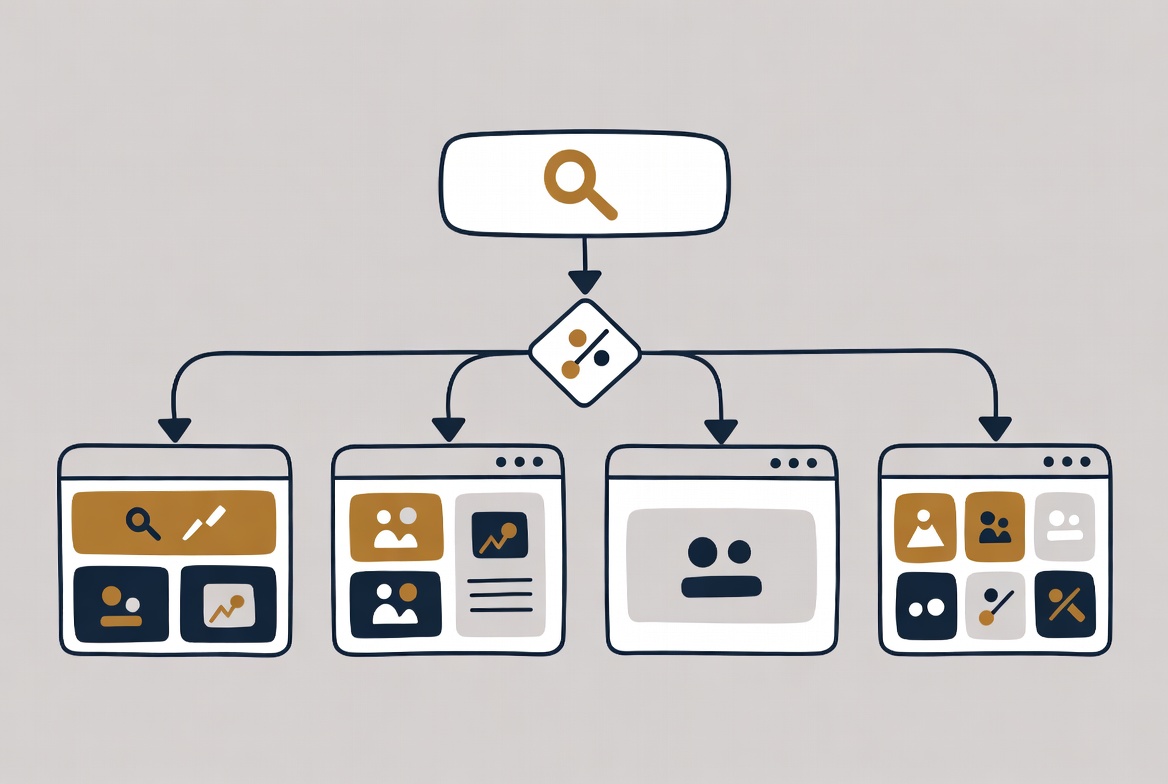
The Four Intent Types
The standard taxonomy of search intent:
Informational intent: The searcher wants to learn something. These queries typically start with “what,” “how,” “why,” “when,” or are a direct topic question. Examples: “what is a content delivery network,” “how JWT authentication works,” “kubernetes vs docker.”
Navigational intent: The searcher wants to find a specific page or site. Examples: “GitHub login,” “Stripe documentation,” “Netlify dashboard.” These queries are generally not addressable by content unless you are the destination being searched for.
Commercial investigation intent: The searcher is evaluating options before making a decision. Examples: “best database for SaaS,” “Vercel vs Netlify,” “Stripe alternatives.” These want comparison content, reviews, and feature breakdowns.
Transactional intent: The searcher wants to complete an action, usually a purchase, signup, or download. Examples: “buy domain name,” “sign up Cloudflare,” “download PostgreSQL.” These want landing pages and clear calls to action.
Reading the SERP to Determine Intent
The most reliable way to determine the expected intent and format for a specific query is to look at what is currently ranking. The SERP is Google’s revealed preference for that query. As search becomes more AI-driven, understanding these signals matters more than keyword density alone. Our guide to adapting to AI search covers how AI overviews and result formats are changing ranking dynamics.

For any keyword you plan to target:
- Search the keyword in Google in an incognito window
- Note the dominant content format across the top 5-10 organic results
- Note the SERP features present (featured snippet, how-to schema, video results, knowledge panel)
- Note the approximate content depth (are the results long-form guides or short answers?)
Format signals to look for:
- List posts (top 10, best, comparison): “best Node.js frameworks,” “top PostgreSQL extensions”
- Step-by-step guides (numbered steps, how-to schema): “how to set up Docker Compose,” “how to configure NGINX”
- Definition/explainer (short, direct): “what is eventual consistency,” “what is a webhook”
- Long-form guides: “complete guide to TypeScript generics,” “kubernetes deployment tutorial”
- Comparison pages: “React vs Vue vs Angular,” “PostgreSQL vs MySQL for SaaS”
When 8 of the top 10 results are list posts, publishing a long-form tutorial targeting the same keyword is a format mismatch. You are providing a different format than what searchers expect and Google has learned to serve.
Applying Intent to Content Structure

Informational: Tutorial/How-To Format
For queries like “how to implement authentication in Express”:
The searcher wants a specific, actionable answer. The content should:
- Answer directly in the opening paragraph, not after a long preamble
- Use numbered steps for sequential processes
- Include runnable code examples
- Cover prerequisites explicitly (“this guide assumes Node.js 18+ and basic Express knowledge”)
- Address the most common errors or variations people encounter
The optimal length is determined by the topic complexity, not by an arbitrary word count target. A “how to set a cookie in Express” guide should be short. A “how to implement OAuth 2.0 from scratch” guide should be thorough.
Commercial Investigation: Comparison Format
For queries like “Vercel vs Netlify for Next.js”:
The searcher wants to make a decision. The content should:
- State the conclusion early (for those who want a quick answer)
- Compare specific relevant dimensions (pricing, build times, edge network, Next.js-specific features)
- Be honest about trade-offs and which option suits which use case
- Include a comparison table for scannable reference
- Be updated when prices or features change
Comparison content that refuses to take a position (“both are great, it depends!”) is less useful than content that provides a clear recommendation with stated criteria.
Informational: Definition Format
For queries like “what is a service mesh”:
The searcher wants a clear, accurate explanation. The content should:
- Define the term directly in the first sentence
- Explain why it exists / what problem it solves
- Provide a concrete analogy or example
- Cover related terms and how they connect
- Be appropriately concise. A definition page that becomes a 3,000-word guide has misread the intent
Check if a featured snippet is present for the query. Featured snippets are awarded to content that answers concisely in 40-60 words. Structure the definition to be extractable as a featured snippet: a clear, standalone paragraph that answers the query without requiring context.
Featured Snippet Optimization

Featured snippets appear above organic results for many informational queries. Capturing the featured snippet effectively means ranking position zero.
Types of featured snippets:
-
Paragraph snippets: A 40-60 word paragraph that directly answers a question. Target these by writing a clear, direct answer to the query phrase within the first 100 words of the article, ideally under a heading that matches the question.
-
List snippets: A numbered or bulleted list. Target these by using
<ol>or<ul>for step-by-step processes or ranked items. Keep list items concise. -
Table snippets: Comparison data in table format. Target these by using structured HTML tables for comparisons.
<!-- Structure for targeting a definition snippet -->
## What is a load balancer?

A load balancer distributes incoming network traffic across multiple servers to
prevent any single server from becoming a bottleneck, improving application
availability and response time.

[Continue with fuller explanation...]
The heading should match or closely paraphrase the search query. The answer paragraph should be self-contained and precise.
Intent Classification at Scale

For sites with large keyword lists, manually analyzing SERP intent for each keyword is impractical. Tools provide automated signals:
Semrush and Ahrefs classify keywords by intent in their keyword explorer tools. While not perfectly accurate, the automated classification is a useful starting point for sorting large keyword sets.
SERP feature analysis: Ahrefs’ SERP overview shows which SERP features are present for a keyword. How-to schema present suggests step-by-step format. Video results suggest the query may prefer video. Knowledge panel suggests navigational or branded intent.
Word-level patterns: Batch classify your keyword list by common intent signals:
- How/Why/What/When → informational
- Best/Top/Compare/vs/Alternative → commercial investigation
- Buy/Download/Get/Pricing → transactional
- [Brand name] + anything → navigational
This classification is rough but provides enough signal to prioritize which keywords need deep SERP analysis versus which can be addressed with predictable content formats.
Measuring Intent Match
After publishing or updating content with an improved intent match, track:
Ranking position change: Did the page improve for the target keyword?
Click-through rate (CTR) from GSC: A title and meta description that matches the expected intent (comparison title for a commercial investigation query, step-by-step title for a how-to query) should improve CTR.
Bounce rate and time on page: Content that matches intent gets engaged readers. High bounce rates on a ranking page often indicate an intent mismatch. The page ranks but does not satisfy the underlying query. Engagement metrics are also influenced by page experience signals, which our Core Web Vitals SEO impact guide breaks down in detail.
Intent analysis is the foundation of content strategy. Volume and competition matter, but a low-competition keyword where you match intent correctly will outperform a high-competition keyword where your content format is wrong.